




Court clarifies that parole is neither suspension nor remission of sentence; date of the parole application, not the date of conviction, will determine the applicable rules
Jaipur: In a significant ruling on the law governing the release of prisoners on parole, a Full Bench of the Rajasthan High Court has held that the Rajasthan Prisoners (Release on Parole) Rules, 2021, will govern every application for temporary or permanent parole filed after June 30, 2021, irrespective of the date on which the prisoner was convicted.
The Court has ruled that a prisoner cannot claim a vested right to have a subsequent parole application considered under the repealed Rajasthan Prisoners (Release on Parole) Rules, 1958, merely because the conviction took place when the old rules were in force.
The Full Bench also clarified that parole does not amount to suspension, remission or commutation of a sentence. It is a conditional release that changes only the mode in which a prisoner undergoes the sentence. The period spent on parole, including permanent parole, is treated as imprisonment served under Rule 10 of the 2021 Rules.
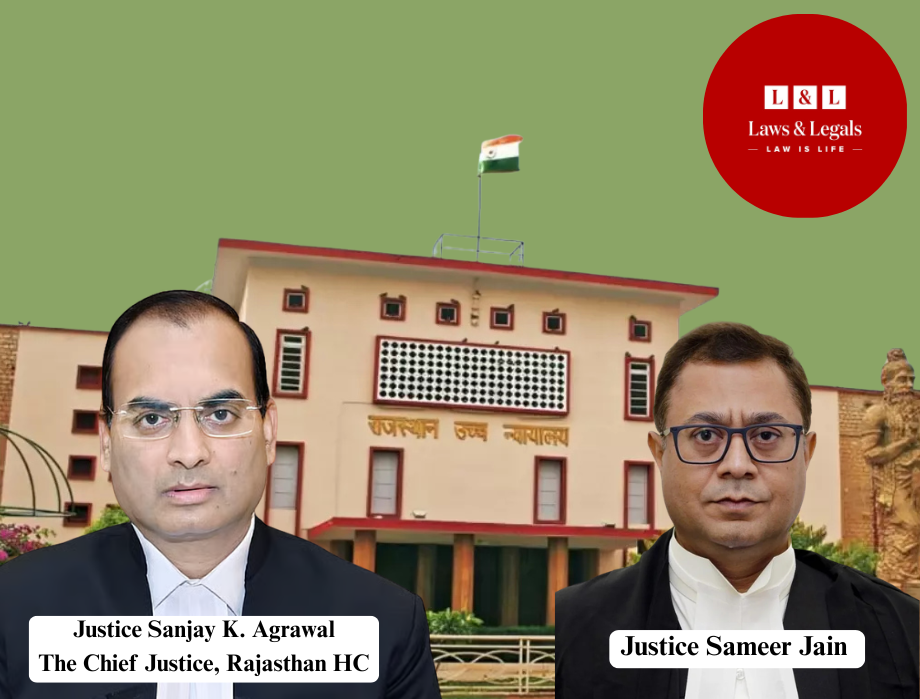
The judgment was delivered on November 21, 2026, in D.B. Civil Reference No. 4/2026. The Bench comprised Chief Justice Sanjay K. Agrawal, Justice Anoop Kumar Dhand and Justice Sameer Jain. The judgment was reserved on November 4, 2026.
Reference arose from conflicting judicial views
The reference arose after a Division Bench, by an order dated October 29, 2026, noticed divergent judicial views on whether a prisoner’s parole application should be governed by the rules prevailing on the date of conviction or by the rules in force when the parole application is considered.
The matter originated in D.B. Civil Writ Petition No. 12101/2026, filed in the matter of Ashok, son of Nibhori Lal, a resident of Kharagpura village in Dholpur district, who was confined in the Open Air Camp, Karauli. His elder brother, Hari Babu, had approached the Court on his behalf.
The reference was connected with eight other writ petitions: D.B. Civil Writ Petition Nos. 12102/2026, 12103/2026, 12104/2026, 12106/2026, 12107/2026, 12108/2026, 12109/2026 and 12111/2026.
The Division Bench referred three questions of law for determination by a Larger Bench:
Whether the 1958 Rules prevailing on the date of conviction would govern a parole application, or whether the 2021 Rules in force at the time of consideration of the application would apply.
Whether grant of parole amounts to temporary suspension of sentence under Section 386 of the Code of Criminal Procedure, 1973, corresponding to Section 427 of the Bharatiya Nagarik Suraksha Sanhita, 2023 (BNSS).
What is the effect of the repeal of the CrPC and its replacement by the BNSS on the applicability and operation of the 1958 Parole Rules.
Parole is a reformative measure linked to human dignity: Court
While explaining the purpose of parole, the Full Bench observed that its object is to facilitate the rehabilitation of a convict into mainstream society on the principles of compassion and human consideration.
Referring to the Supreme Court’s judgment in Poonam Lata v. M.L. Wadhawan and Others, the Court noted that release on parole is a part of the reformative process and provides a prisoner an opportunity to transform into a useful citizen.
The Bench also referred to Inder Singh and Another v. State (Delhi Administration), observing that parole helps prisoners maintain family ties and prevents the further accumulation of emotional and psychological tensions.
The judgment emphasised that parole is connected with human dignity, which forms part of the protection guaranteed under Article 21 of the Constitution of India.
It also referred to the observations quoted from Lewis Moore, highlighting that rehabilitation cannot be achieved through brutality or disrespect and that prisoners must continue to be treated as human beings.
Relying on State of Haryana v. Nauratta Singh, the Court reiterated that during the parole period, the sentence continues to run and is not suspended.
Parole and remission are legally different
A significant part of the judgment distinguishes parole from remission of sentence.
The Court explained that in parole, the sentence imposed by the court remains unchanged. The prisoner is temporarily permitted to leave prison, subject to conditions and supervision, while continuing to serve the sentence.
Remission, on the other hand, affects the execution of the sentence by reducing the period of imprisonment that the convict is required to undergo. The Court observed that remission may ultimately result in premature release, whereas parole does not alter the sentence itself.
In this context, the Full Bench discussed the Constitution Bench judgment in Maru Ram v. Union of India, as well as the Supreme Court decisions in State of Haryana v. Jagdish and Hitesh @ Bavko Shivshankar Dave v. State of Gujarat.
The Court explained that the principle requiring the remission policy prevailing on the date of conviction to be considered in cases of premature release cannot automatically be extended to parole or permanent parole. Since parole does not reduce or alter the sentence, the rules applicable when the entitlement to the benefit arises are relevant.
1958 Rules expressly repealed by 2021 Rules
The Court examined the legislative framework governing parole in Rajasthan.
The 1958 Rules had been framed under Section 401(6) of the Code of Criminal Procedure, 1898, and came into force on December 20, 1958. Rule 13 of those rules treated parole as a concession to encourage good conduct and clarified that prisoners could not claim it as a matter of right.
The Court noted that the Prisons Act, 1894, was amended by Rajasthan through the Prisons (Rajasthan Amendment) Act, 2015. Section 58-A was introduced to provide for the release of prisoners on parole in accordance with rules made by the State Government. Clause (27-a) was also inserted in Section 59(1), empowering the State to frame rules on the subject.
Exercising this power, the Rajasthan Government framed the Rajasthan Prisoners (Release on Parole) Rules, 2021, which came into force on June 30, 2021, upon publication in the Official Gazette.
The Full Bench pointed out that Rule 2(g) of the 2021 Rules defines parole as the conditional release of a prisoner from jail. Rule 15 provides that parole is a concession intended to encourage good conduct and cannot be claimed as a matter of right.
Importantly, Rule 25(1) expressly repealed the 1958 Rules. Rule 25(2), however, saved the previous operation of the repealed rules and actions already taken under them.
The Court held that the saving provision protects the previous operation of the old rules, but does not permit fresh parole applications filed after their repeal to be considered under those rules.
BNSS does not revive the repealed rules
The Full Bench also examined the effect of the transition from the CrPC, 1973, to the BNSS, which came into force on July 1, 2024.
The Court noted that the 2021 Rules were independently framed under Section 59 of the Prisons Act, 1894, read with Rule 27-a, and were not dependent on the continued existence of the old CrPC provisions.
It further held that Section 531(2)(b) of the BNSS preserves only those rules that were in force immediately before July 1, 2024. The provision neither affects the operation of the 2021 Rules nor revives the 1958 Rules, which had already been expressly repealed with effect from June 30, 2021.
The Bench relied upon the Supreme Court’s decisions in Qudrat Ullah v. Municipal Board, Bareilly and State of Rajasthan v. Mangilal Pindwal while examining the legal consequences of repeal and substitution of statutory provisions.
Three questions of law answered by the Full Bench
Answering the reference, the Full Bench laid down the following legal position:
First: The Rajasthan Prisoners (Release on Parole) Rules, 2021, will apply to every application for temporary or permanent parole filed after June 30, 2021, irrespective of the date of conviction. A conviction under the 1958 regime does not create a vested right to have a later parole application considered under the repealed rules.
The Court also clarified that the principles laid down in Jagdish and Hitesh @ Bavko Shivshankar Dave, which concern the remission policy applicable at the time of conviction in cases of permanent release, do not extend to parole or permanent parole.
Second: Grant of parole does not amount to suspension, remission or commutation of sentence. It is a conditional release that changes only the mode of undergoing the sentence. Under Rule 10 of the 2021 Rules, the period spent on parole, including permanent parole, is treated as imprisonment served.
Third: The 1958 Rules, which had continued after the enactment of the CrPC, 1973, by virtue of Section 484(2)(b), were expressly repealed by Rule 25(1) of the 2021 Rules with effect from June 30, 2021. The 2021 Rules were independently framed under Section 59 of the Prisons Act, 1894, read with Rule 27-a. Section 531(2)(b) of the BNSS preserves the rules in force immediately before July 1, 2024, and neither affects the 2021 Rules nor revives the 1958 Rules.
After answering the three questions, the Full Bench disposed of the reference and directed that the connected writ petitions be placed before the appropriate Bench having the roster for consideration on their merits. The Full Bench did not decide the individual entitlement of the petitioners to parole.
Appearance
Advocate General Rajendra Prasad appeared for the State of Rajasthan, assisted by Rajesh Choudhary, GA-cum-AAG, Harshita Thakral and Neha Goyal. Shobhit Tiwari appeared with Pushpendra Singh Tanwar and Rohit Tiwari for the respondents.
For the petitioners, Anshuman Saxena appeared with Dharamsheel Sharma, Manisha Agarwal and Divyansh Saini; Shiv Charan Gupta with Harsh Saraswat and Tarun Singhal; Kapil Gupta with Ajay Ghadwal; Jai Lodha with Ankit Rathore; Abhishek B. Sharma with Deependra Yadav; Rajesh Kala with Avi Airun, Jitendra Mitruka and Harshit Sharma; Anubhav Agarwal with Hemang Kumawat; Chain Singh Rathore with Vikas Meena and Banwari Lal Sharma; Prem Chand Dewanda with Riya Choudhary; and P.L. Saini with Pawan Kumar.
Other counsel appearing for the petitioners were R.S. Sinsinwar, Dharmendra Kumar Bairwa, Chitransh Saxena, Anisha Yadav, Abhay Singh Rathore, Tanay Choudhary, Aval Yadav, Sunil Yadav, Ramsharan Singh, Dheeraj Singhal, Adv. Saral Sharma, Katyani Singh, Vishram Prajapati, T.C. Swami, Siddharth Jain Mutha, Achin Singhal, Kapil Choudhary, Himanshu Dholia, Abhishek Singh Devanda, Muskaan Jalu, Ramveer Saini, Govind Rawat, Kalu Rram Bhati, Amit Sharma and Rahul Soni. Kalu Rram Bhati, Amit Sharma and Rahul Soni appeared through video conferencing.