




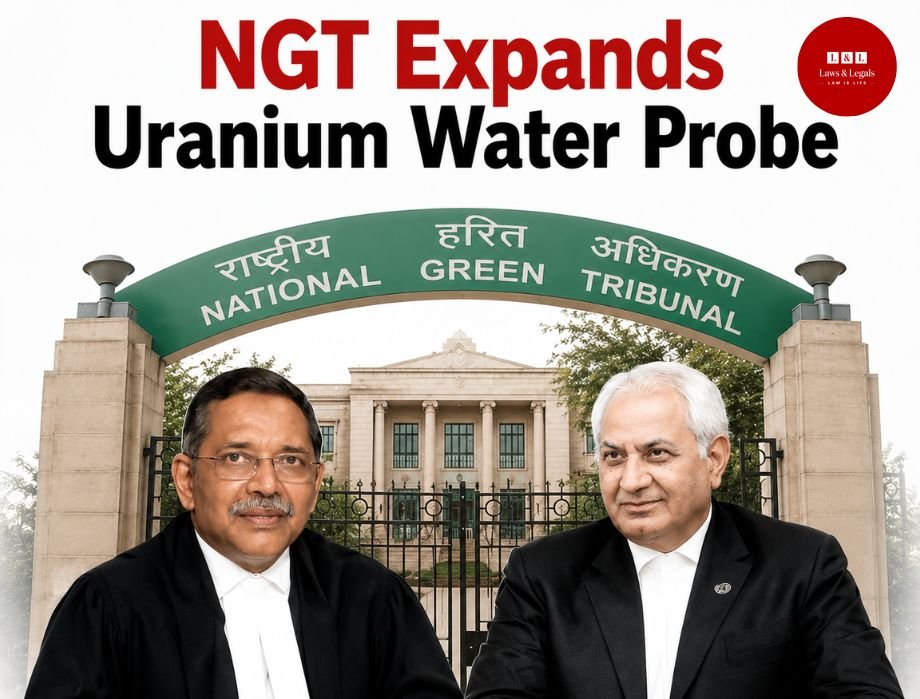
New Delhi: The National Green Tribunal (NGT) has expanded the scope of proceedings concerning uranium contamination in groundwater after taking judicial notice of a media report indicating elevated uranium levels in groundwater samples collected from Delhi.
A Bench comprising NGT’s Chairperson Justice Prakash Shrivastava and Expert Member Afroz Ahmad, while hearing a suo motu matter that was initiated on the basis of a news report regarding the detection of uranium in breast milk across six districts of Bihar, impleaded the Delhi Government and Delhi Pollution Control Committee (DPCC) as party in the case.
During the hearing, the Tribunal referred to a media report based on the Central Ground Water Board’s (CGWB) Annual Ground Water Quality Report 2025, which stated that 24 out of 83 groundwater samples collected in Delhi exceeded the prescribed uranium limits, accounting for nearly 13–15% of the samples analysed.
The report also identified north-western India, including Delhi, Punjab, Haryana, parts of Rajasthan, and Uttar Pradesh, as uranium contamination hotspots, attributing the contamination primarily to geogenic factors, groundwater depletion, and aquifer characteristics.
Taking note of these findings, the tribunal impleaded the Delhi Pollution Control Committee (DPCC) through its Member Secretary and the Government of the National Capital Territory of Delhi (GNCTD) through its Principal Secretary (Environment) as additional respondents. The Registry was directed to issue notices to the newly added parties.
The tribunal has listed the matter for further hearing on September 24.
Further, the Bench recalled its earlier order dated December 20, 2022, concerning uranium contamination in Bihar’s groundwater.
It noted that a Joint Committee comprising the Central Pollution Control Board (CPCB), Bihar State Pollution Control Board (BSPCB), Central Ground Water Authority (CGWA), and senior officials of the Bihar Government had then concluded that uranium concentrations in Bihar’s groundwater were generally within the range of natural variation, although a limited number of localized hotspots exceeding the permissible limit of 30 parts per billion (ppb) had been identified.
The tribunal had, at that time, directed the Public Health Engineering Department (PHED), Bihar, to continue monitoring such locations and ensure safe drinking water for affected residents.