


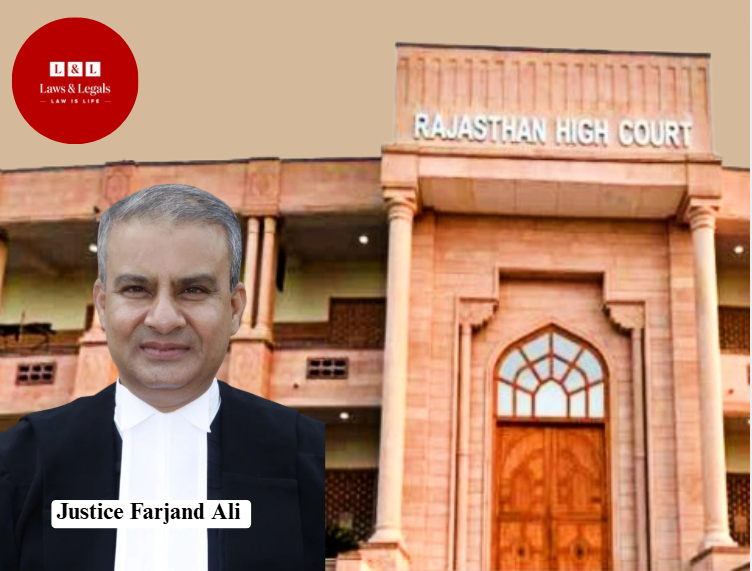


Jodhpur: The claim of ancestral property cannot rest solely on a family relationship, the Rajasthan High Court has ruled while examining a dispute over 75 bighas of agricultural land in Jaisalmer.
Justice Farjand Ali held that a grandson must establish the property’s coparcenary character before claiming a share in it by birth.
Dispute arose after sale of land
The land in Jaimla village, Jaisalmer, was originally allotted to Chutra Ram as a landless person. After his death without leaving a will, the land passed equally to his three sons—Khetaram, Ramaram and Lachchuram, in accordance with the Hindu Succession Act.
Devaram, the son of Khetaram, claimed that the land was ancestral and that he had acquired a 1/9th share by birth.
He challenged subsequent sale deeds concerning the property, alleging that his interest had been transferred without his consent.
Court finds no foundation for coparcenary claim
The High Court found that Devaram’s plaint did not state that Chutra Ram had held the land on behalf of an HUF or joint Hindu family. It also did not explain how the property had acquired or retained a coparcenary character.
Referring to the Supreme Court’s ruling in Uttam v. Saubhag Singh, Justice Farjand Ali held that property inherited by a son under Section 8 does not automatically become ancestral property giving his son a birthright.
The Court also held that Devaram’s minority when his grandfather died did not alter the succession that had already taken place under law.
Sale deed challenge also faced jurisdictional bar
The Court also found a separate difficulty with Devaram’s challenge to the sale deeds.
His case was depended on an alleged khatedari right in the agricultural land, but he had not obtained a declaration of such right from the competent revenue court.
The court held that Devram could not challenge the sale deeds in a civil court without first establishing khatedari rights.
The High Court found no reason to interfere with the trial court’s decision and dismissed the appeal.