





Jodhpur: The Rajasthan High Court has held that an incorrect fixation of an employee’s last pay may constitute a “continuing wrong” even after retirement if it results in an incorrect pension being paid every month.
However, the Court clarified that such a finding does not entitle an employee to claim arrears for an unlimited period, particularly when the claim is brought after an unexplained delay.
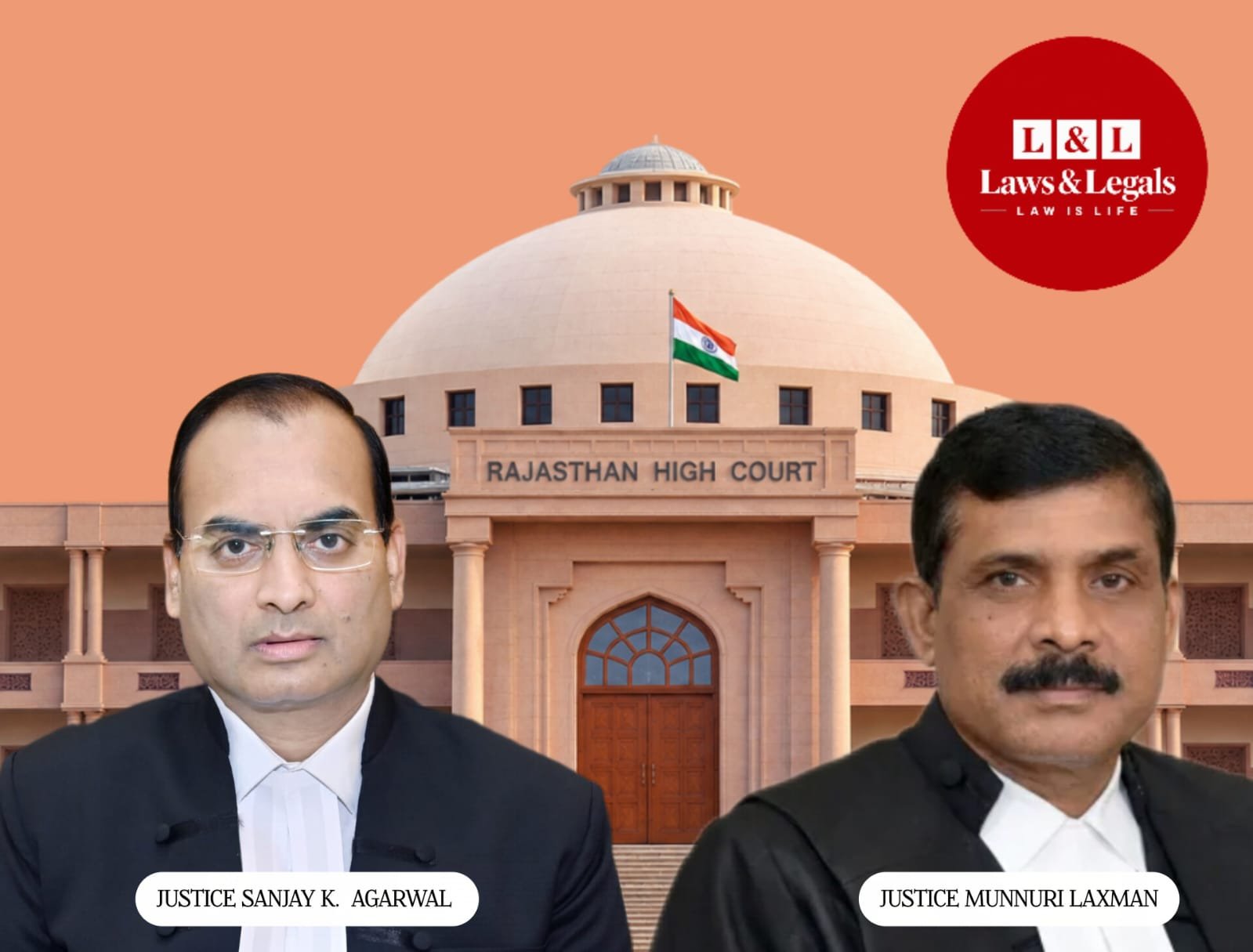
A Division Bench comprising Justice Sanjay K. Agrawal and Justice Munnuri Laxman made the observations while dismissing an appeal filed by Majid Khan, who had approached the Court more than 10 years after his retirement seeking consequential financial benefits arising from an alleged incorrect pay fixation.
Dispute Over Pay Fixation
Khan was initially appointed as a work-charged Mohrir in the Forest Department in 1983 and was later transferred to the post of Gram Sevak-cum-Pradhan Sachiv in 2000. He retired in 2009.
His grievance was that after his appointment as Gram Sevak, his pay was fixed in the lower pay scale applicable to a Mohrir instead of the higher scale applicable to a Gram Sevak.
He claimed that this incorrect fixation also affected his pension and gratuity.
The record showed that his pay was notionally re-fixed in 2010 for pension purposes, but the consequential monetary benefits were not paid to him. He subsequently challenged the denial of these benefits before the High Court.
Pension Error Can Give Rise to a Continuing Cause of Action
The Bench considered the principles laid down by the Supreme Court in M.R. Gupta v. Union of India and Union of India v. Tarsem Singh, under which an incorrect pay fixation resulting in recurring financial loss may constitute a continuing wrong.
The High Court observed that the principle can also apply to a retired employee where an incorrect fixation of the last pay continues to affect the monthly pension. Since pension is paid periodically, the wrong may have a continuing effect and give rise to a recurring cause of action.
However, the Court made it clear that the doctrine of continuing wrong cannot be used to overcome an unreasonable delay in claiming old arrears.
Arrears Ordinarily Restricted to Three Years
Relying on the Supreme Court’s precedents, the Bench held that even where an error in pay fixation is treated as a continuing wrong, the consequential arrears would ordinarily be restricted to three years preceding the filing of the writ petition.
In Khan’s case, the Court noted that his pay had already been notionally re-fixed in 2010, while he approached the Court only after about a decade. In these circumstances, the Court declined to grant consequential monetary benefits for the prolonged period of delay.
Gratuity Claim Treated Differently
The Court also rejected the claim concerning gratuity, drawing a distinction between pension and gratuity.
While pension is a recurring monthly payment, gratuity is a one-time benefit. Therefore, an alleged shortfall in gratuity cannot ordinarily be treated as a continuing wrong. The claim, having been raised after a prolonged and unexplained delay, was consequently hit by delay and laches.
Delay of 10 Years not Justified
The Bench also noted that since the employee’s pay had already been notionally re-fixed, no dispute regarding the basic pay fixation remained. The surviving issue was only the consequential monetary benefit, which could not be claimed indefinitely after such a long delay of almost 10 years.
The Division Bench accordingly dismissed the appeal, while laying down the important principle that an incorrect pay fixation affecting a retired employee’s monthly pension may amount to a continuing wrong, but the resulting arrears will ordinarily be limited to three years, and one-time benefits such as gratuity remain subject to the bar of delay and laches.