




Court Upholds Cancellation of Retirement Order but Sets Aside Reinstatement Direction, Citing Absence of a Specific Plea for Reinstatement in the Original Petition
Jaipur: The Rajasthan High Court has held that a government employee’s request to extend or withdraw voluntary retirement must be considered if it is made before the retirement takes effect. The Court observed that the absence of a specific provision prescribing a procedure for extending the retirement date does not mean that such a request can be ignored.
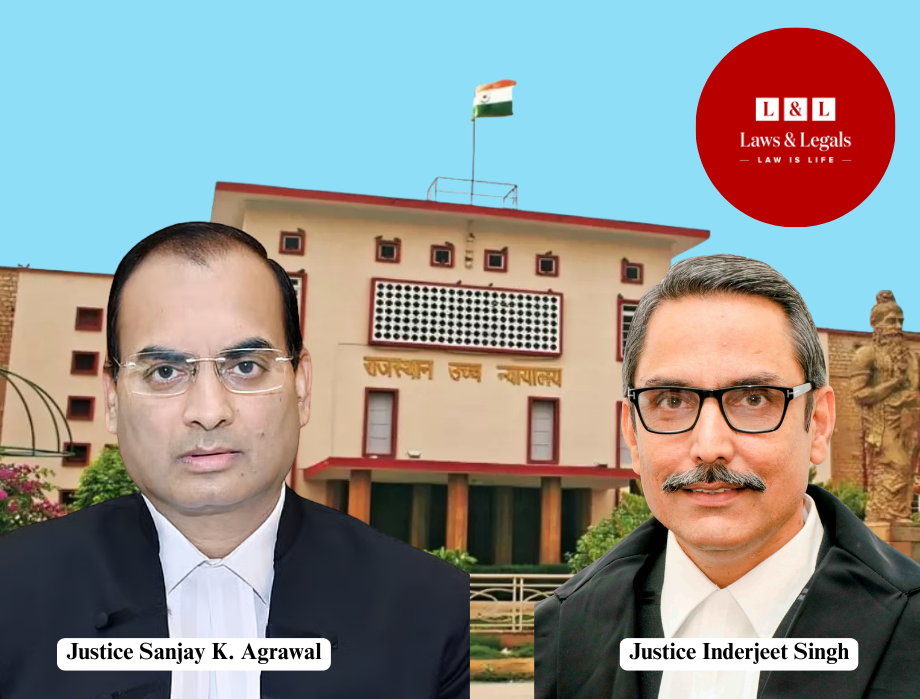
A division bench of Chief Justice Sanjay K. Agrawal and Justice Inderjeet Singh delivered the ruling while deciding separate appeals filed by H.K. Meena and the Rajasthan government.
The bench upheld the decision to quash Meena’s voluntary retirement order dated October 30, 2014. However, it set aside the direction to reinstate him, holding that he had not specifically sought reinstatement in his original writ petition.
Government Employee Sought Extension of Voluntary Retirement
H.K. Meena was working as an Assistant Commercial Taxes Officer in the Rajasthan government’s Commercial Taxes Department when he applied for voluntary retirement on health grounds.
The state government initially approved an extension of his retirement date from July 31, 2014, to October 31, 2014, through an order dated July 23, 2014.
On October 29, 2014, Meena again requested an extension, this time for six months, citing an improvement in his health.
However, the government rejected his request on October 30, 2014, and ordered his voluntary retirement with effect from the afternoon of October 31, 2014.
Meena subsequently applied for withdrawal of the retirement order, but the government did not decide his request. He then approached the Rajasthan High Court challenging the retirement order.
Single Judge Had Ordered Reinstatement
On January 25, 2017, a single judge of the Rajasthan High Court quashed the retirement order and directed the state government to reinstate Meena within four weeks.
The single judge, however, restricted the benefits relating to salary, annual increments and seniority for the period from October 30, 2014, to January 25, 2017, to pension-related purposes.
Both Meena and the state government challenged the decision. While Meena sought continuity of service and other consequential benefits, the state government challenged the direction requiring his reinstatement.
Request Made Before Retirement Took Effect Must Be Considered
The division bench examined Rule 50 of the Rajasthan Civil Services (Pension) Rules, 1996, which governs voluntary retirement and generally requires an employee to give at least three months’ written notice, subject to the applicable requirements.
The Court noted that the rules do not expressly prescribe a separate procedure for extending the date of voluntary retirement. However, it clarified that this does not prohibit an employee from making such a request.
The bench observed that Meena had sought an extension before his retirement took effect and had made it clear that he did not wish to retire on the scheduled date.
In these circumstances, the state government could not pass the retirement order without considering his pending request.
The High Court, therefore, found no error in the single judge’s decision to quash the October 30, 2014 retirement order.
Supreme Court Judgments on Withdrawal of Resignation Considered
The division bench referred to the Supreme Court’s decision in Union of India v. Gopal Chandra Misra, which discusses the general principle governing the withdrawal of a resignation intended to take effect at a future date.
The principle recognises that a future-effective resignation may generally be withdrawn before it takes effect, unless a legal, contractual or constitutional restriction applies.
The bench also referred to Bharat Amratlal Kothari v. Dosukhan Samadkhan Sindhi and Union Public Service Commission v. Nasir-ud-Din Wani while examining the legal principles relevant to the dispute.
Reinstatement Set Aside Because It Was Not Specifically Sought
While upholding the quashing of the retirement order, the division bench identified a procedural limitation in the single judge’s decision.
It found that Meena’s original writ petition sought the quashing of the retirement order and consideration of his request, but did not specifically seek reinstatement in service.
The bench held that a court cannot grant relief that a petitioner has not sought in the original petition. Accordingly, the direction requiring the government to reinstate Meena could not be sustained.
The Court clarified that setting aside the retirement order would preserve Meena’s entitlement to other consequential benefits available to him under the law, but would not entitle him to reinstatement under the relief granted in these proceedings.
High Court Modifies Single Judge’s Order
The division bench modified the single judge’s January 25, 2017 order to the extent that it directed Meena’s reinstatement. The decision quashing the voluntary retirement order dated October 30, 2014, was left undisturbed.
With these modifications, the High Court disposed of both appeals and directed the parties to bear their own costs.