






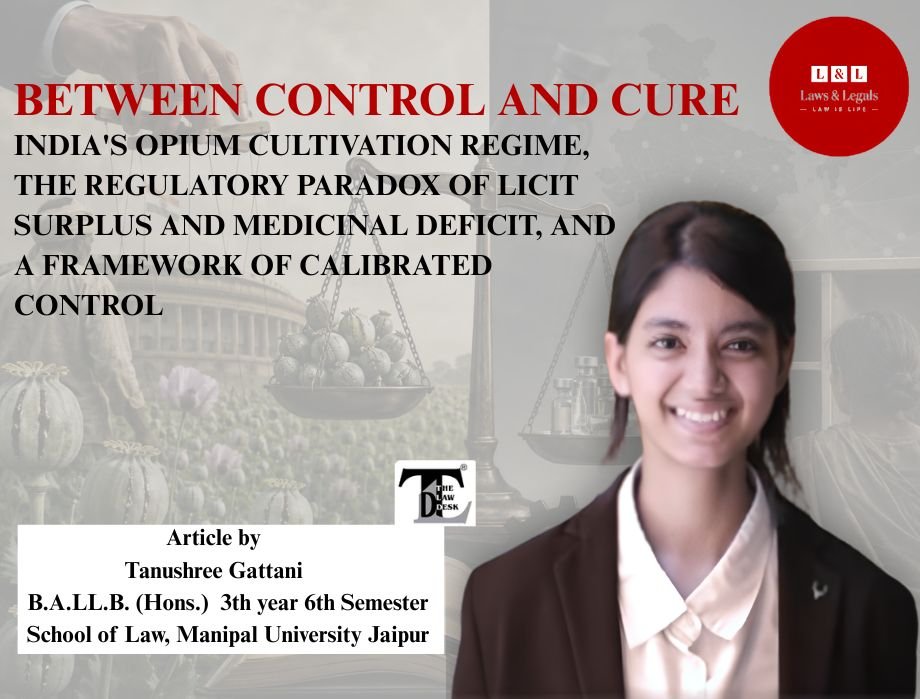
The Law Desk: India is the world’s only authorized producer of licit gum opium under Article 23 of the United Nations Single Convention on Narcotic Drugs, 19611, but it also ranks among the world’s lowest consumers of medicinal morphine, creating an anomaly in global narcotics governance that has no exact counterpart. In the twelve years after the Narcotic Drugs and Psychotropic Substances Act, 1985 (NDPS Act)2 was passed, morphine consumption decreased by about 97%, from 716 kilograms in 1985 to 18 kilograms by 1997, according to data compiled from government reports submitted to the International Narcotics Control Board (INCB). During the same period, global consumption increased by 437%3. By 2014, the entire amount of morphine consumed annually had dropped to just 278 kg. At 75 milligrams per patient per day for ninety days, this amount was enough to treat just 40,000 terminal cancer patients in a nation where there are an estimated 2.5 million cancer patients who require pain medication4.
The Regulatory Paradox of Licit Surplus and Medicinal Deficit is a condition in which the same legal framework that permits large-scale opium production for international pharmaceutical markets simultaneously creates barriers through mis calibrated production economics, supervisory architecture, and downstream dispensing regulation that prevent adequate patient access to the medicines that production is intended to supply, according to this article. The Paradox is a structural result of fundamental design decisions whose consequences are both empirically quantifiable and constitutionally cognizable under Article 21 of the Constitution5. It is not an accidental policy failure.
There are two unique contributions made by the article. In order to provide a transferable framework for comparative narcotics law studies, it first presents the Paradox as an analytical category applicable to every producer state that complies with the Convention but is unable to convert licit production into domestic medical access. Second, it develops a theory of calibrated control based on Black’s risk-based regulatory framework6 and Ayres and Braithwaite’s responsive regulation theory7. In this theory, regulatory stringency at each stage of the opium lifecycle is set in proportion to the specific diversion risk at that stage rather than being applied consistently as a blunt instrument across production, processing, and dispensing.
I. The Regulatory Paradox: Empirical And Normative Dimensions
A. Empirical Foundations
India has a significant capacity to produce opium illegally. According to the INCB’s Narcotic Drugs Technical Report, India continuously ranks among the top producers of opiate raw materials; in recent crop years, the country has produced between 400 and 800 metric tons of licit opium gum annually8. The Ministry of Finance announced eligibility for about 1.21 lakh (121,000) licensed cultivators in Madhya Pradesh, Rajasthan, and Uttar Pradesh for the 2025-2026 crop year. This is a 23.5% increase over the previous year. All procured opium is processed at two Government Opium and Alkaloid Works (GOAF) facilities in Ghazipur and Neemuch9.
The morphine access data shows the Paradox’s structural depth as compared to this manufacturing capability. According to the WHO/WHPCA Global Atlas of Palliative Care (2020), morphine usage for palliative reasons was over 33 milligrams per capita in high-income countries and less than 5 milligrams per capita in low and middle-income countries10. In Kerala, the state with the most advanced palliative care infrastructure in India, the amount of morphine used per person varied by 19 times between districts in 2015, ranging from 0.49 to 2.97 milligrams per capita11. Kerala is at the top of the Indian distribution; most states do much worse. These numbers are well below the WHO’s suggested acceptable access level.
The paradox is made worse by deviating from the legal chain. In a peer-reviewed analysis published in Addiction, Paoli, Greenfield, and Reuter calculated that 200-300 tonnes of India’s licit opium may be diverted into illicit markets each year based on INCB production data and UN prevalence estimates, potentially ranking India third among illicit opium producers12. Although independent analyses point to greater numbers, official Indian government estimates recognize a diversion rate of about 10% of licit production13. According to the UNODC’s analysis specific to India, 39% of the country’s opium seizures took place in the three states with licensed cultivation, which is clear proof of licit-to-illicit diversion rather than independent illicit cultivation14.
Downstream fragmentation was somewhat addressed by the 2014 NDPS Amendment, which established the Essential Narcotic Drugs (ENDs) framework and centralized END regulation under the Union Government15. Post-amendment research, however, attest to the persistence of structural barriers: Vikram et al.’s PMC-indexed assessment discovered that the access gap persists due to implementation failures, insufficient healthcare provider training, ongoing state-level restrictiveness, and supply chain bottlenecks16. The 2014 amendment largely resolved the Paradox by reforming the downstream end while keeping the upstream production economics and supervisory architecture mostly unaltered.
B. Normative Dimensions: Article 21 and the Dual Mandate of the 1961 Convention
The Paradox involves aspects related to international law and constitutional law, making it more than just a policy inefficiency. A regulatory system that manufactures morphine but prohibits its administration to terminal patients is unconstitutional due to the Supreme Court’s broad reading of Article 21, which includes the right to health and dignified end-of-life care17. In a peer-reviewed analysis, Shetty et al. describe the ongoing morphine availability gap as a flagrant infringement of the human right to a dignified existence18.
Bewley-Taylor and Jelsma’s authoritative assessment of the 1961 Convention at the international level shows that the treaty incorporates a twin mandate: facilitating access to medicines and preventing illicit usage.19 As the INCB’s 2022 Annual Report indicates, balance in the availability of opioids is part of the right to health and the Sustainable Development Goals, and major differences exist between high-income and low-income countries20. India’s regulatory environment is in a situation of constructive conflict with its own Constitution and the treaty whose obligations it is giving effect to, as the ban mandate is always given precedence over the access requirement.
II. The Legal Architecture: Critical Analysis
A. Structure and Tensions
The prohibition-and-exception structure of the NDPS Act is based on Article 47’s medicinal exception, Entry 59 of Union List I21, and Rule 8 of the 1985 Rules, which provides the licensing exception. Section 8 of the NDPS Act establishes general prohibition22. Under this architecture, the Central Bureau of Narcotics (CBN) administers the Minimum Qualifying Yield (MQY) mechanism, which requires cultivators to tender a minimum morphine-content yield per hectare as a condition of licence renewal. This yield is currently set at 4.2 kg morphine per hectare for gum opium producers, with a forewarning threshold of 5.9 kg per hectare for the following year’s eligibility.23
The material currently in publication undervalues the inherent structural tension that the MQY mechanism conveys. It was created as a diversion prevention tool and treats yield shortfalls resulting from agronomic or climatic factors in the same way as shortfalls brought on by intentional diversion. By applying the same punitive consequence, licence revocation, to two distinct compliance failure types, this conflation results in what Responsive Regulation theory would describe as a mismatched enforcement reaction24. In the Indian setting, Ayres and Braithwaite’s enforcement pyramid model accurately predicts that uniform punitive reactions to non-compliance undermine regulatory legitimacy and drive regulated actors toward non-cooperation rather than internalization of the regulatory norm25. The State of Rajasthan v. Daulat Ram26 court’s acknowledgement that NDPS punitive application must take subsistence farming circumstances into account reveals an implicit
The Supreme Court’s holding in Tofan Singh v. State of Tamil Nadu (2021)27 that CBN officers constitute ‘police officers’ for Section 25 of the Evidence Act, rendering their receipt of admissions inadmissible has increased the evidentiary burden in diversion prosecutions and raised the premium on documentary chain-of-custody records, precisely the category of evidence most vulnerable to the corruption that characterises CBN’s field data environment.
The downstream aspect of the paradox results from the split of authority between the Union (Entry 59, List I) and the States (Entry 51, List II): the 2014 amendment’s Union-level change does not immediately harmonize State Excise laws governing the dispensing of morphine. According to Rajagopal and Joranson’s peer-reviewed analysis28, some states have dispensing requirements that are so onerous that they discourage healthcare providers from stocking morphine, thereby negating the Union legislation’s liberalization at the point of patient access.
In this case, Black’s risk-based regulatory framework29 is helpful for diagnosis. Instead of distributing compliance costs evenly among all cultivators through increasing MQY thresholds, a risk-based approach would focus the most intensive regulatory resources on the points of highest diversion risk in the opium supply chain, the lancing-and-collection stage in licensed fields, where manual extraction creates multiple opportunities for underreporting.
III. Comparitive Insights: Turkey And Australia
What India’s architecture lacks structurally and what the 1961 Convention’s institutional duties under Article 23 genuinely allows is revealed by a focussed comparison with Turkey and Australia.
In 1974, Turkey, a co- “traditional producer” under the 1961 Convention, switched from growing gum opium to poppy straw after large amounts of illicit opium were diverted into the creation of heroin30. No seizures of opium made from Turkish poppies have been reported anywhere since the transfer, according to the UNODC.31 This result is explained by two structural characteristics. First, to ensure constant field presence throughout harvest, the Turkish Grain Marketing Board (TMO) employs around 350 committed field officials, equivalent to roughly 70,000-100,000 licensed smallholder farmers, at an annual control cost of about USD 6 million.32 Second, Turkish farmers get paid based on the alkaloid content of their crop rather than a government-fixed price per kilogram of gum, which is more significant for India’s reform objective. The price-gap incentive, which the UNODC describes as the main structural driver of diversion in India’s system, is eliminated, the economic return to adulteration or dilution is eliminated, and farmer income is directly aligned with pharmaceutical value under this pricing structure.33
Under the licensing framework of the Poppy Advisory and Control Board, Australia, and particularly Tasmania, which provides almost half of the world’s legal narcotic raw materials34, uses a mechanically harvested, vertically integrated, privately contracted approach. The key diversion vulnerability that is structurally irreducible in India’s manual gum opium system is closed by mechanically harvesting whole dried plants, which completely removes the lancing-and-collection stage. The two licensed processing corporations oversee overseeing their contracted producers, and farmers are once more compensated based on the level of alkaloids.35 In actuality, the diversion record is zero.
Three analytically accurate findings are drawn from the comparison analysis. First, the most easily reformable structural reason of the Paradox’s diversion dimension is the absence of alkaloid-contentrelated price from Indian architecture, which is the only design element most consistently connected to reduced diversion across both comparators. Second, Turkey’s and Australia’s models are both compliant with the 1961 Convention’s Article 23 institutional obligation, which requires governmental control of the production chain but does not specify any specific pricing mechanism, harvesting technique, or farmer-incentive structure. This shows that India’s current architecture reflects contingent design choices rather than treaty necessity. Third, India’s unique position as producer of gum opium (Australia produces poppy straw concentrate; Turkey no longer produces gum) imposes significant constraints on transplanting wholesale structure but does not preclude adoption of the pricing model that evidence shows is most effective in reducing diversion.
IV. Caliberated Control: Framework And Reforms
A. The Framework
This article’s version of Calibrated Control combines Black’s risk-based regulatory philosophy with the enforcement pyramid of Responsive Regulation36 to create a theory of narcotics governance in which the intensity of regulatory intervention at each stage of the opium lifecycle is specifically set in proportion to: (i) the specific diversion risk profile at that stage; (ii) the ability of regulated actors to internalize compliance norms at that stage; and (iii) the medicinal access objective required by the dual mandate of the 1961 Convention. The framework views medicinal access and diversion prevention as equally important regulatory goals that are not subordinated to one another. The empirical diversion risk data, rather than institutional default toward prohibition, determines the relative weighting of these goals at any particular stage of the supply chain.
When applied to the opium lifecycle in India, Calibrated Control identifies three specific miscalibrations in the current architecture: the field supervision stage is under-resourced in relation to the diversion risk it is intended to address; the downstream dispensing stage is over-restricted in relation to the diversion risk it presents, creating the access gap that constitutes the most socially harmful dimension of the Paradox; and the upstream production stage is mis calibrated through fixed-price procurement, misalign farmer incentives without addressing the highest-risk supervisory gap.
B. Reform 1 Alkaloid-Content-Linked Procurement Pricing
The implementation of procurement pricing according to the morphine content per kilogram of tendered opium, in place of the current volume-based fixed price, is the most structurally significant reform possible under the current NDPS Act framework. The Central Government already has the authority to control procurement prices under Section 9(1)(b) of the NDPS Act, and the GOAF already checks every shipment for morphine. No new laws are required; however, implementation calls for an updated price formula in the Annual Licensing Policy Gazette notification. In addition to improving pharmaceutical-grade alkaloid yield for the domestic medical supply chain, this reform aligns India’s incentive structure with Turkey’s evidence-based model and tackles the main structural driver of diversion highlighted by the UNODC.
C. Reform 2 CPS Transition with Crop Insurance
A significant structural step is represented by the 2025-2026 Annual Licensing Policy’s CPS pathway for farmers who achieve between 3.0 and 4.2 kg morphine per hectare with a five-year licence validity37. India’s main point-of-harvest diversion vulnerability is closed by CPS cultivation, which removes the lancing stage. For confirmed natural production shortages, this shift should be expedited and combined with a crop insurance program similar to the Pradhan Mantri Fasal Bima Yojana, which separates license revocation from natural disasters. Crop insurance directly addresses this within the Responsive Regulation framework’s preference for compliance-supportive over punitive responses when the regulated actor’s non-compliance is exogenous rather than wilful, as noted by Rajagopal and Joranson. The current MQY revocation risk for naturally caused shortfalls structurally incentivizes diversion as income insurance.
D. Reform 3 Technology-Integrated Field Supervision
With 121,000 smallholder plots to supervise over a shortened harvest season, the CBN’s field supervision problem cannot be remedied by more field officers on their own. In addition to being legally permitted under Section 9 of the NDPS Act, a technology-integrated supervisory architecture is empirically required: blockchain-based chain-of-custody tracking from weighment centre through GOAF to pharmaceutical procurement (creating an unchangeable audit trail); GPS geotagging of licensed plots (replacing paper plot records susceptible to manipulation); and satellite remote sensing for cultivated area verification (already implemented for illicit crop detection). The digital infrastructure base was established in 2025-2638 with the launch of the CBN Online Portal for license applications; these changes extend it to the operational functions where integrity breaches most immediately allow diversion.
E. Reform 4 National Minimum Standards for Opioid Dispensing
Legislative harmonization is necessary to address the Paradox’s downstream aspect. A Model State Narcotic Drugs Rules instrument should be used to operationalize the 2014 amendment’s ENDs framework and centralize END regulation under the Union Government, creating nationally consistent minimum standards for morphine stocking at Community Health Centres and district hospitals. The competence gap between Entry 59 (Union) and Entry 51 (States), which results in the inter-state dispensing variation reported by Rajagopal et al.39, is immediately addressed by this reform. These requirements should be incorporated into the health system framework provided by the National Programme for Palliative Care (2012) and the National Health Policy (2017). Kerala’s improved palliative care access outcomes, which were made possible by a progressive State Drug Controller policy, mandatory physician training, and NGO infrastructure, show that there is domestic regulatory capacity for this harmonization; the form needs to be replicated at the national minimum standard level.
Conclusion
Three analytically distinct design miscalibrations are responsible for the structural paradox that India’s NDPS opium cultivation architecture embeds: volume-based fixed pricing that misaligns farmer incentives with diversion prevention; a field supervision architecture that is insufficient to address lancing-stage diversion risk; and an intergovernmental competence division that permits State-level regulatory fragmentation to nullify Union-level access reforms at the point of patient delivery. This article makes three contributions to socio-legal scholarship: it presents the Regulatory Paradox of Licit Surplus and Medicinal Deficit as a novel analytical category that can be applied to any producer state that complies with the Convention and exhibits the same structural misalignment; it develops Calibrated Control, which is theoretically based on Responsive Regulation and riskbased regulatory frameworks, as a diagnostic and prescriptive tool for stage-specific, riskproportionate intervention; and it shows through comparative analysis that India’s current architecture reflects both Convention-compliant and empirically superior alternatives.
The regulation has reversed its own constitutional and treaty justification when a state produces opium only for medical purposes, but its regulatory framework keeps those medications from reaching patients who have a recognized clinical need. The 1961 Convention’s dual mandate, Article 21’s guarantee of dignified life, and Article 47’s medicinal exception together create an affirmative legal obligation to calibrate, not just to control. The reforms put forth here represent the particular legislative and administrative actions necessary to fulfil this obligation.
References
1.United Nations Single Convention on Narcotic Drugs, 1961, 520 U.N.T.S. 151, Art. 23
2.NDPS Act, 1985, Act No. 61 of 1985
3.Salins, N., Bhatnagar, S., Simha, S. et al. Palliative Care in India: Past, Present, and Future. Indian J Surg Oncol 13 (Suppl 1), 83-90 (2022). https://doi.org/10.1007/s13193-022-01556-0
4.Aasems Jacob et al. End-of-Life Care and Opioid Use in India: Challenges and Opportunities. JGO 3, 683686(2017), DOI:10.1200/JGO.2016.008490
5.India Const., Art. 21; Paschim Banga Khet Mazdoor Samity v. State of West Bengal, (1996) 4 SCC 37
6.Black, J. (2010), Risk-based regulation: choices, practices and lessons learnt; In Risk and Regulatory Policy: Improving the Governance of Risk (pp. 185-224), OECD, https://doi.org/10.1787/9789264082939-11-en
7.Ayres, Ian, and John Braithwaite, Responsive Regulation: Transcending the Deregulation Debate (New York, NY, 1992; online edn, Oxford Academic, 31 Oct. 2023), https://doi.org/10.1093/oso/9780195070705.001.0001
8.INCB, Narcotic Drugs: Estimated World Requirements Statistics for 2023, U.N. Doc. E/INCB/2023/2 (2024)
9.Ministry of Finance, Dept. of Revenue, G.S.R. 622(E), Notification No. 02/2025-Narcotics Control-1 (11 Sept. 2025); Ministry of Finance, Press Information Bureau (12 Sept. 2025)
10. WHO & WHPCA, Global Atlas of Palliative Care, 2nd ed. (2020), at 5, Table 1
11. M.R. Rajagopal et al. Oral Morphine Use in South India: A Population-Based Study, JGO 3, 720-727(2017), DOI:10.1200/JGO.2016.007872
12. Paoli, L., Greenfield, V.A., Charles, M. and Reuter, P. (2009), The global diversion of pharmaceutical drugs. Addiction, 104: 347-354. https://doi.org/10.1111/j.1360-0443.2008.02511.x
13. D. Mansfield, An Analysis of Licit Opium Poppy Cultivation: India and Turkey, UNODC/CBN (2006), davidmansfield.org/home/docs/field/4.pdf
14. UNODC, Licit Opium Production in India (2006), citing Narcotics Control Bureau, Annual Report 2003
15. NDPS (Amendment) Act, 2014; R. Rajagopal, M. (2016) “Civil-society driven drug policy reform for health and human welfare – India,” Journal of pain and symptom management. Doi: 10.1016/J.JPAINSYMMAN.2016.10.362
16. Rajagopal, M. (2016). Access to palliative care: insights into ground realities post-2014 amendment to NDPS Act. Indian journal of medical ethics. 13. 25-30. 10.20529/IJME.2016.006
17. Parmanand Katara v. Union of India, (1989) 4 SCC 286
18. Supra note 3
19. B. Bewley-Taylor & M. Jelsma, Fifty Years of the 1961 Single Convention on Narcotic Drugs: A Reinterpretation, 12 International Journal of Drug Policy 482, 483–485 (2012)
20. INCB, Report of the INCB for 2022, U.N. Doc. E/INCB/2022/1 (2023)
21. India Const., Art. 47; Sch. VII, Union List I, Entry 59
22. NDPS Act, 1985, §§ 8, 9; NDPS Rules, 1985, Rule 8
23. G.S.R. 622(E), supra note 9, cl. 2(i) (4.2 kg/ha MQY-M); cl. 2(i)
24. Supra note 6
25. Ibid
26. State of Rajasthan v. Daulat Ram, 1980 Cri. L.J. 929 (Raj.)
27. Tofan Singh v. State of Tamil Nadu, (2021) 4 SCC 1
28. Rajagopal MR, Joranson DE. India: opioid availability. An update. J Pain Symptom Manage. 2007 May;33(5):61522, Doi: 10.1016/j.jpainsymman.2007.02.028. PMID: 17482057
29. Supra note 7
30. Ibid
31. Transform Drug Policy Foundation, Turkey’s Opium Trade (2017)
32. Supra note 13
33. Supra note 31
34. Supra note 13, 14
35. Department of Natural Resources and Environment Tasmania, Tasmanian Poppy Industry, https://nre.tas.gov.au/agriculture/multifaceted-agriculture/plant-industries/tasmanian-poppy-industry
36. NSW Parliament, Report on the Statutory Review of the Poppy Industry Act 2016 (2022), Table 3 (fee and incentive structure comparison)
37. Supra note 9
38. Ibid
39. Supra note 11