







Rule 19 Dispenses with Regular Departmental Enquiry but it does not automatically justify dismissal from authority; Authority Must Examine Conduct, Circumstances and Proportionality of Penalty, independent consideration warranted.
Jodhpur: The Rajasthan High Court has held that while a government employee convicted in a criminal case can be proceeded against under Rule 19 of the Rajasthan Civil Services (Classification, Control and Appeal) Rules, 1958 without a regular departmental enquiry, but the conviction by itself does not automatically justify dismissal from service.
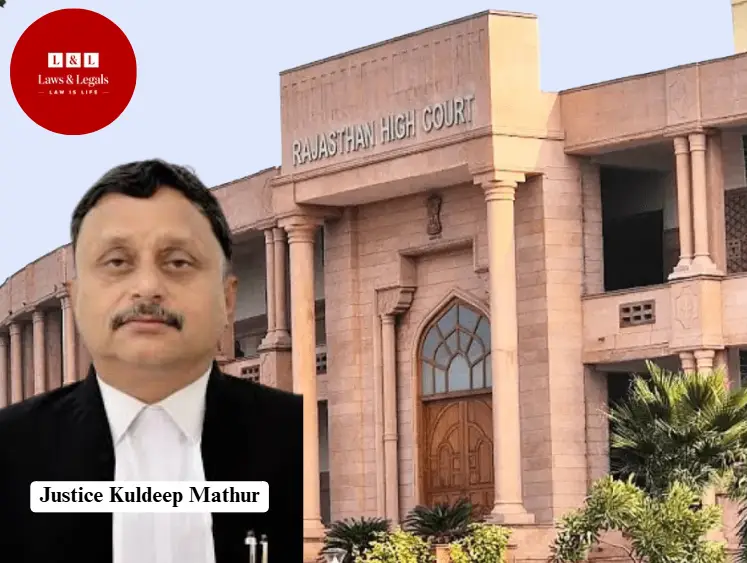
Justice Kuldeep Mathur set aside the dismissal of a Veterinary Assistant who had been convicted in a criminal case, finding that the disciplinary authority had mechanically imposed the maximum penalty of dismissal without considering the relevant circumstances or recording reasons for choosing dismissal over other available penalties.
For the context, the petitioner, Dalveer Singh Rajawat, was appointed as a Pashudhan Sahayak in the Rajasthan Animal Husbandry Department in 1986 and was later promoted as a Veterinary Assistant.
In 2020, he was placed under Awaiting Posting Order after a criminal case was registered against him.
He was later convicted by a Special Court in 2021. Although his sentence was later suspended, his conviction remained in force. Relying on the conviction, the department dismissed him from service under Rule 19 of the 1958 Rules.
Rajawat challenged the dismissal before the Rajasthan High Court, contending that the authority had imposed dismissal without properly considering the circumstances and proportionality of the penalty.
Rule 16 and Rule 19
The Court first made an important distinction between Rule 16 and Rule 19 of the 1958 Rules.
While Rule 16 ordinarily requires a departmental enquiry before imposing major penalties, Rule 19 creates a special procedure where the penalty is based on conduct that has led to the government employee’s conviction on a criminal charge.
The Court explained the key legal principle that Rule 19 removes the requirement of a regular departmental enquiry, but does not remove the duty to consider the circumstances of the case.
The conviction though provided foundational power to exercise power given under Rule 19 but whether the penalty should be imposed or not is a independent matter for consideration by the authority.
The authority must examine the conduct leading to the conviction, the circumstances in which the offence was committed, the nature and gravity of the employee’s role, and other relevant factors concerning his retention in government service before deciding the appropriate penalty.
Court also Relied on the Constitution Bench judgment in Union of India v. Tulsiram Patel, the Court held that in such cases, a regular departmental enquiry is not required. However, this does not mean that the disciplinary authority can automatically dismiss the employee merely because a conviction exists.
HC: “Conviction Does Not Automatically Entail Dismissal”
The Court reiterated from Tulsiram Patel decision, that a criminal conviction does not automatically entail dismissal, removal or reduction in rank.
The disciplinary authority must first consider whether the conduct that resulted in the conviction warrants a penalty and, if so, which penalty would be appropriate in the circumstances.
Authority Cannot Fill the Gaps Later Through Its Court Reply
The petitioner had been dismissed by an order which, according to the Court, merely recorded his conviction and stated that the conduct made his continued retention in public service undesirable.
The Court found that the order did not explain what conduct led to the conviction, how that conduct was relevant to his service, or why dismissal was necessary when other penalties, including removal and compulsory retirement, were available under Rule 14.
“Reasons for exercising statutory discretion have to be found in the order itself,” the Court observed.
Principle of Proportionality, Must Be Examined
The Court also stressed the importance of proportionality while exercising the power under Rule 19.
It clarified that the High Court was not substituting its own view on the appropriate punishment. Rather, interference was warranted because the disciplinary authority had failed to undertake the statutory exercise of determining what penalty was justified in the facts of the case and had straightaway imposed the severest penalty.
Consequently, the Court quashed the dismissal order. However, it clarified that the State authorities remain free to reconsider the matter afresh under Rule 19(i).
Back Wages restricted to 50%
The Court also restricted the petitioner’s back wages to 50%, keeping in view the peculiar facts and the principle of “no work, no pay.”