




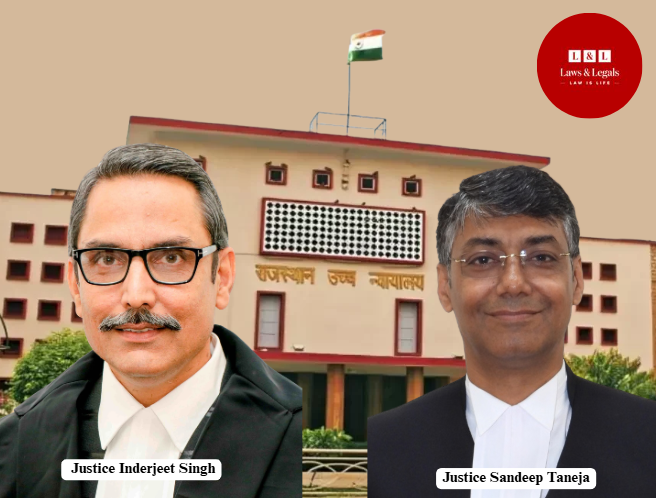
Jodhpur: The Rajasthan High Court has allowed appeals filed by the state government and the Rajasthan Public Service Commission (RPSC), setting aside a single judge’s January 10, 2025, order concerning the Assistant Professor Recruitment 2021.
A division bench of Justice Inderjeet Singh and Justice Sandeep Taneja held that amendments made to recruitment rules after the selection process has begun cannot ordinarily be applied to an ongoing recruitment unless they are expressly given retrospective effect.
The ruling means that the single judge’s directions to conduct the recruitment under the amended rules notified on May 23, 2022, and to limit interview weightage to a maximum of 10 per cent will no longer operate.
The bench also considered that the petitioner, Dr. Rachita Mathur, had not disclosed an earlier petition filed before the Jodhpur Bench, had participated in the selection process without raising a timely objection and approached the Court after a considerable delay.
The High Court accordingly dismissed her writ petition.
Recruitment for 337 Assistant Professor Posts, Dispute Over Interview Weightage
The RPSC issued an advertisement on November 27, 2021, for recruitment to 337 Assistant Professor posts in the Medical Education Department. The vacancies covered 43 subjects in broad and super-speciality disciplines. The last date to apply was December 22, 2021.
Dr. Rachita Mathur applied for the post of Assistant Professor in Skin and VD, for which three vacancies had been advertised.
Under the recruitment advertisement, selection was to be made through interviews. The Commission could also conduct a screening test to restrict the number of candidates if it received a large number of applications.
Accordingly, a screening examination for the Skin and VD subject was held on May 6, 2022. Its answer key was released on June 10, 2022
The dispute arose over the weightage assigned to the screening test, academic marks and interview during the recruitment process.
May 23, 2022 Notification Changed the Selection Criteria
On May 10, 2022, the RPSC Full Commission decided the weightage for different stages of selection.
For subjects where no screening test was conducted, it decided to give 40 per cent weightage to academic marks and 60 per cent to the interview.
For subjects where a screening test was held, the proposed weightage was 40 per cent for the screening test, 20 per cent for academic marks and 40 per cent for the interview.
Subsequently, on May 23, 2022, the state government’s Department of Personnel notified the Rajasthan Various Services (Second Amendment) Rules, 2022.
The amendment provided that interview marks could carry a maximum weightage of 10 per cent of the total selection marks. Rule 19 of the Rajasthan Medical Service (Collegiate Branch) Rules, 1962, was also amended.
Mathur argued that the recruitment should follow the amended rules and that the interview weightage should be restricted accordingly.
The state government and RPSC opposed the plea, arguing that the recruitment had begun with the advertisement issued on November 27, 2021. Therefore, the rules introduced later could not be applied retrospectively to the ongoing selection process.
Earlier Petition Before Jodhpur Bench Not Disclosed
During the appeal, the state government brought to the Court’s attention that Mathur had earlier filed a petition before the Rajasthan High Court’s Jodhpur Bench.
According to the state, she had filed Civil Writ Petition No. 8167/2023 on May 31, 2023, along with other petitioners. That petition also challenged the interview weightage in the same recruitment and sought to limit it to a maximum of 12.5 per cent.
The Jodhpur Bench dismissed the petition on July 10, 2023, as premature.
Mathur subsequently filed another petition in 2024 but did not disclose the earlier proceedings.
The state placed this information on record through an additional affidavit during the appeal.
The division bench observed that the jurisdiction exercised by the High Court under Article 226 of the Constitution is extraordinary and discretionary. A person seeking such relief must make a full and fair disclosure of all material facts.
The Court said that it is not for the petitioner to decide which facts are important and which are not. All relevant facts must be placed before the Court so that it can assess their significance.
Court Rejects Explanation That Colleague May Have Filed Earlier Petition
On behalf of Mathur, it was argued that a colleague might have obtained her signed vakalatnama and filed the earlier petition without her knowledge.
The division bench did not accept this explanation.
It noted that Mathur had not filed a counter-affidavit in response to the additional affidavit submitted by the state government. As a result, the fact that the earlier petition had been filed remained undisputed.
The Court also observed that Mathur was a highly educated person holding a postgraduate degree in medical science. It found it difficult to accept that a colleague could have obtained her signature on a vakalatnama and filed a petition without her knowledge.
The bench treated the explanation as an attempt to cover up the non-disclosure of a material fact.
It held that the petitioner had not approached the Court with clean hands by withholding details of the earlier petition. This was also a ground on which relief under Article 226 could be denied.
However, the bench clarified that it was also deciding the appeals on the substantive legal issues involved.
Rules Amended After Advertisement Cannot Automatically Apply to Ongoing Recruitment
The central legal question before the division bench was whether the amended Rule 19, notified on May 23, 2022, could apply to a recruitment process that had begun with the advertisement dated November 27, 2021.
The bench noted that the amended rules provided that they would come into force from the date of their publication in the Official Gazette. They did not contain any provision giving them retrospective effect.
Accordingly, the amendments came into force on May 23, 2022.
Referring to Supreme Court decisions, including Assam Public Service Commission and Tej Prakash Pathak, the High Court reiterated the legal principle that recruitment ordinarily begins with the issuance of the advertisement and continues until the advertised vacancies are filled.
The selection criteria are generally governed by the rules applicable when the recruitment process begins.
Changes introduced during an ongoing recruitment cannot ordinarily alter the selection criteria unless the amendment expressly provides for retrospective application or the existing rules permit such a change.
The bench found that the earlier version of Rule 19 was in force when the recruitment advertisement was issued. The amendment came approximately six months after the process had begun.
It therefore held that the amended Rule 19 could not be applied to this recruitment.
Amended Rule Changed the Entire Selection Structure
The single judge had treated the amended Rule 19 as procedural in nature and applied it to the recruitment. The division bench disagreed with this view.
It noted that under the earlier rules, selection was primarily based on interviews.
The amended rules changed the structure by introducing a two-stage selection process involving a written examination and an interview. They also limited interview weightage to 10 per cent.
According to the division bench, this was not merely a procedural change relating to the processing of applications. It substantially altered the selection system and could affect the candidates’ position in the recruitment.
The Court therefore held that the amendment could not be treated as a purely procedural change.
The bench also referred to the RPSC’s letter dated July 21, 2022, seeking clarification from the state government on the applicability of the amended rules.
The state government, through its response dated July 28, 2022, had clarified that the recruitment should be completed under the rules applicable on the date of the advertisement.
40 Per Cent Interview Weightage Not Automatically Unconstitutional
Mathur also argued that assigning 40 per cent weightage to interviews was excessive and contrary to the principles laid down by the Supreme Court in Ajay Hasia and Ashok Kumar Yadav.
She further contended that the advertisement did not clearly mention the distribution of marks.
The state government and RPSC argued that the recruiting authority was entitled to determine the weightage assigned to different stages of selection. The Commission had fixed the weightage for the screening test, academic marks and interview based on its decision.
The division bench referred to the Supreme Court’s decisions in Lila Dhar v. State of Rajasthan and other cases. It observed that the proportion of marks assigned to written examinations and interviews need not be the same for every service.
The weightage may vary depending on the nature of the service, its requirements and the purpose of the selection process.
The High Court also noted that Ajay Hasia concerned admission to an educational institution. Its observations could not be mechanically applied in the same manner to recruitment in public employment.
Relying on Lila Dhar, the bench held that a comparatively higher interview weightage does not, by itself, make a selection process unconstitutional. Judicial interference requires a legally sustainable ground, such as arbitrariness or violation of statutory requirements.
Participation in Selection Process Also Considered
The division bench also considered that Mathur had participated in the selection process under the recruitment advertisement and appeared in the screening test.
The state government and RPSC argued that she had taken part in the process without raising a timely objection and could not challenge the selection criteria later.
Referring to Supreme Court decisions on the issue, the High Court observed that a candidate who participates in a selection process without objection may face legal restrictions when challenging its criteria at a later stage.
The bench also disagreed with the single judge’s finding that Mathur and similarly placed candidates had challenged the alleged irregularities before the screening test.
It noted that the earlier petition, numbered 1777/2022, primarily concerned the filling of backlog vacancies for reserved categories. It did not raise the same challenge to the selection process and interview weightage as the present petition.
The Court therefore held that the petitioners in the two cases could not be treated as being in the same position.
The bench further observed that the record showed that Mathur had not challenged the present selection criteria before the screening test.
Petition Also Hit by Delay of Nearly Two-and-a-Half Years
The High Court also examined the delay in approaching the Court.
The bench noted that, even if the earlier petition was left aside, Mathur had first applied to be impleaded in the relevant proceedings on May 14, 2024.
This was nearly two-and-a-half years after the recruitment advertisement and around two years after the notification amending the rules was issued on May 23, 2022.
She was subsequently given liberty to file a fresh writ petition and did so.
However, the Court found that no satisfactory explanation had been provided for the delay.
The division bench observed that a person seeking extraordinary judicial relief must approach the Court without undue delay and explain the reasons for any substantial delay.
It held that the petition was also affected by the principle of delay and laches.
Single Judge Order Set Aside, State and RPSC Appeals Allowed
After considering the submissions and legal issues, the Rajasthan High Court allowed the appeals filed by the state government and the Rajasthan Public Service Commission.
The division bench set aside the single judge’s order dated January 10, 2025, and dismissed the writ petition filed by Dr. Rachita Mathur.
Additional Advocate General Vigyan Shah appeared for the state government, assisted by Advocate Sankalp Vijay.
Advocates Yuvraj Samant, Neha Amola and Tilak Vaid appeared for the RPSC.