








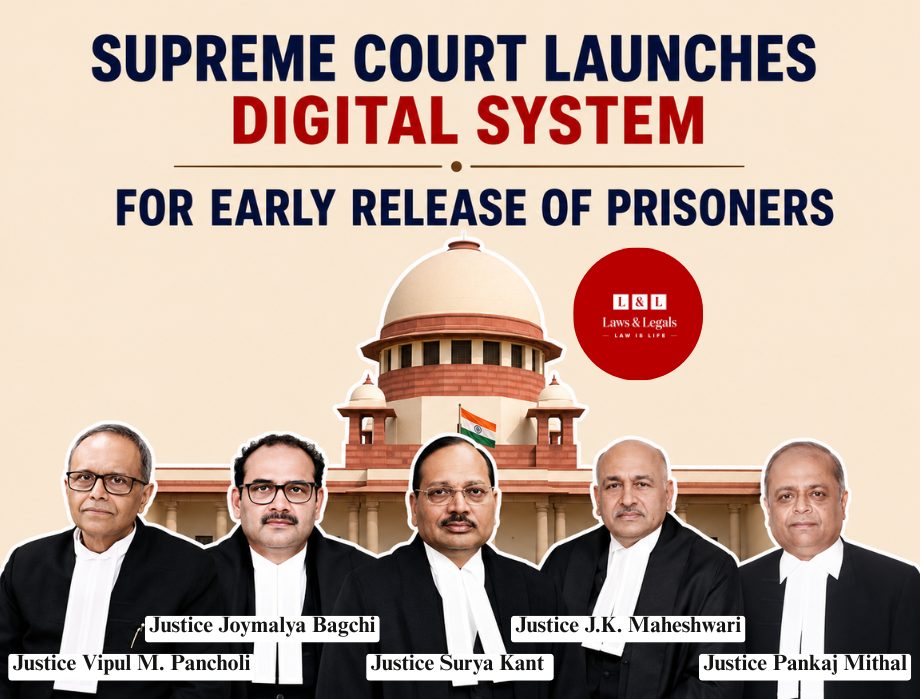
New Delhi: The Supreme Court has taken a significant step to speed up and streamline the premature release of eligible prisoners across India by supporting the launch of a new digital system called the “E-Prisons Early Release Processing Module.”
Developed by the National Informatics Centre (NIC), the software is designed to identify prisoners who have become eligible for early release and ensure their cases are processed without unnecessary delays.
The initiative originated from a criminal appeal filed by a prisoner named Surendra alias Sunda, who had challenged his conviction and life sentence in a murder case.
While hearing the matter, the Supreme Court expanded its focus and examined a larger issue affecting prisons nationwide: thousands of prisoners who had already become eligible for premature release were still behind bars because their cases were stuck in administrative procedures.
The court found that the existing system relied heavily on physical files moving between prison authorities, district administrations, and state governments. This often led to delays lasting months or even years, preventing eligible prisoners from being released on time.
In an important judgment delivered in April 2026, the Supreme Court observed that if a prisoner has fulfilled the legal requirements for early release, continued incarceration due solely to bureaucratic delay is contrary to the principles of justice.
The court therefore directed NIC to create a uniform, automated, and transparent system for processing such cases.
Following those directions, NIC developed the E-Prisons Early Release Processing Module as part of the existing e-Prisons platform.
The software automatically identifies prisoners who have completed the required period of imprisonment or otherwise become eligible for premature release. Once identified, the system digitally forwards their cases to the relevant authorities for consideration.
One of the key features of the software is digital tracking. It records where a file is pending, which official is handling it, and how long it has remained at a particular stage.
This is intended to reduce the possibility of cases being forgotten or delayed indefinitely.
Previously, prison officials had to manually review records to determine which prisoners qualified for early release.
Wherever, the new system automates that process and generates alerts when a prisoner’s eligibility arises, making the entire mechanism faster and more efficient.
A five-judge bench headed by Chief Justice Surya Kant, along with Justice J.K. Maheshwari, Justice Pankaj Mithal, Justice Joymalya Bagchi and Justice Vipul M. Pancholi, noted that the software has now been developed and its implementation has begun across the country.
Satisfied with the progress, the court formally closed the proceedings that had led to the project.
The court has assigned responsibility for implementation to State Legal Services Authorities, prison departments, and other state agencies. These bodies will monitor eligible prisoners’ cases, coordinate with different departments, and help ensure that prisoners receive legal assistance where necessary.
The initiative is being seen as an important prison reform measure. India’s prisons have long faced overcrowding, and delays in releasing eligible prisoners contribute significantly to that problem.
By ensuring that legally eligible prisoners are identified and considered for release on time, the new system is expected to protect prisoners’ rights, reduce overcrowding, improve transparency, and increase accountability within the prison administration.
The broader message of the Supreme Court’s intervention is that once a prisoner becomes legally entitled to consideration for premature release, administrative inefficiency should not become an obstacle to their liberty.
The court’s effort aims to make the process more modern, transparent, and fair for thousands of prisoners across the country.