



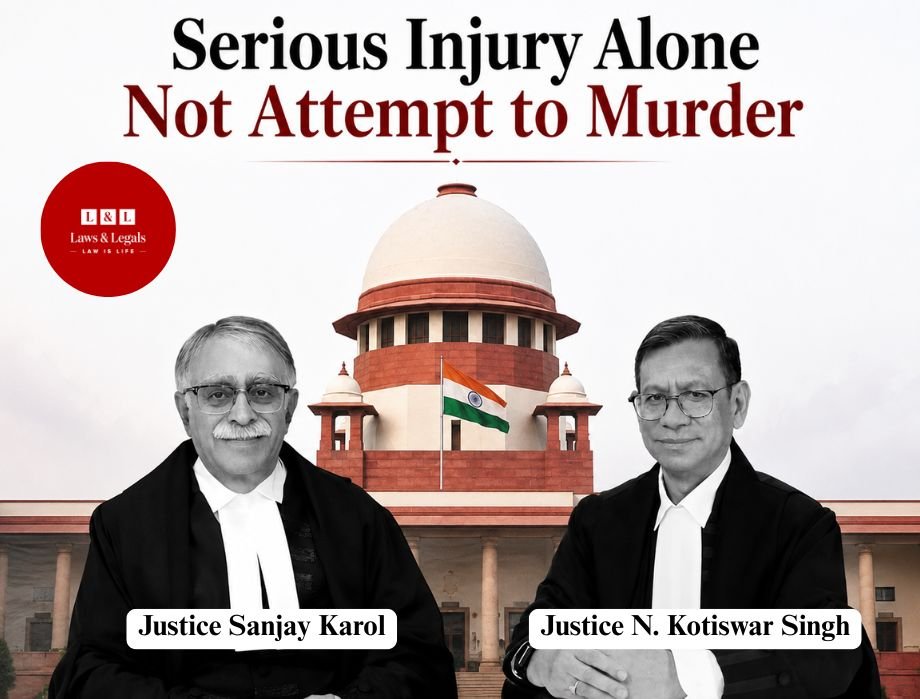
New Delhi: In an important judgement, the Supreme Court has clarified that a serious or life-threatening injury by itself does not automatically prove the offence of attempt to murder.
The top court said that to convict a person under Section 307 IPC, the prosecution must prove not only that the victim suffered serious injuries, but also that the accused intended to kill the victim.
If the intention to cause death cannot be established, a person cannot be convicted under Section 307 merely because the injuries were severe or described as life-threatening in the medical report.
On this basis, a bench of Justice Sanjay Karol and Justice Nongmeikapam Kotiswar Singh modified the conviction of three accused persons from attempt to murder (Section 307 IPC) to voluntarily causing grievous hurt (Section 325 IPC).
The case arose from a village dispute in Rewari, Haryana, in June 2000. Amar Singh, a railway employee, tried to intervene in a quarrel when three men allegedly attacked him with wooden sticks (lathis). He suffered serious head and body injuries, which doctors later described as dangerous to life. Based on the medical opinion, the police added Section 307 IPC to the FIR.
The trial court convicted all three accused under Sections 307 and 506 IPC and sentenced them to seven years’ imprisonment. The Punjab and Haryana High Court upheld the conviction, following which the accused approached the Supreme Court.
The Supreme Court explained that the most important element in an attempt-to-murder case is the intention of the accused. Whether Section 307 applies depends on whether the accused intended to cause death or knew that their act was so dangerous that it would likely result in death. A life-threatening injury alone is not enough.
The court also explained that intention cannot usually be proved directly and must be inferred from the surrounding circumstances. Courts should consider factors such as:
• The weapon used.
• The words or threats made by the accused during the attack.
• Whether there was any previous enmity or motive.
• The part of the body targeted.
• The nature and seriousness of the injuries.
• The manner and force with which the attack was carried out.
The court further clarified that minor injuries do not automatically rule out Section 307 if the circumstances clearly show an intention to kill. Likewise, serious injuries do not automatically justify Section 307 if such intention is absent. Every case must be decided on its own facts.
Applying these principles, the court found that although the accused had caused serious injuries, there was no evidence of a pre-planned attack or any intention to kill. There was no history of prior hostility between the parties.
The incident occurred suddenly when the victim intervened in another quarrel. The accused used ordinary wooden sticks, and there was nothing on record to show that they assaulted the victim with such brutality as to clearly demonstrate an intention to cause death.
Therefore, the court held that the offence of attempt to murder was not made out. However, since the victim suffered grievous injuries, including skull fractures that required prolonged hospitalization, the offence of grievous hurt under Section 325 IPC was established.
Accordingly, the Supreme Court altered the conviction from Section 307 to Section 325 IPC. It held that the period of imprisonment already undergone by the three accused would be treated as sufficient punishment.
However, each of them was directed to pay a fine of ₹50,000, which would be paid to the victim as compensation. If they fail to pay the fine, they will have to undergo an additional six months of simple imprisonment.
This judgment is significant because it reiterates that Section 307 cannot be invoked solely because the victim suffered life-threatening injuries. Investigating agencies and courts must separately establish the accused’s intention to kill by examining the overall facts and circumstances of the case.
The ruling is likely to guide future cases where attempt-to-murder charges are added merely because the injuries are serious.