




New Delhi, The Supreme Court has come down heavily on rampant illegal sand mining in the National Chambal Sanctuary and has ordered several top-ranking officials of the Rajasthan government to appear in person before it on May 20.
expressing serious concern over the continued destruction in the ecologically sensitive sanctuary, home to endangered species such as the gharial.
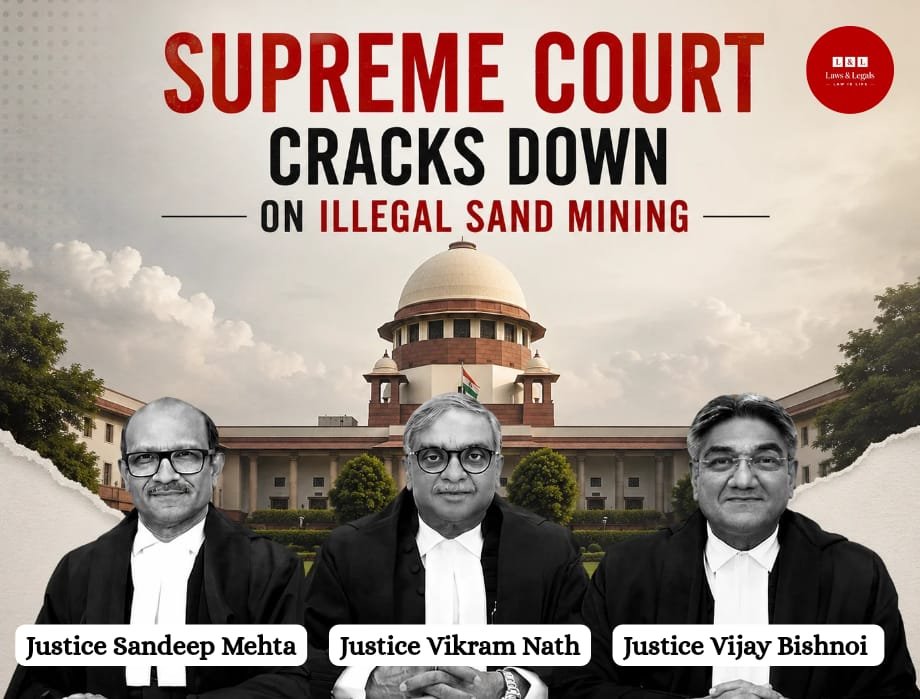
A three-judge bench led by Justice Vikram Nath, along with Justice Sandeep Mehta and Justice Vijay Bishnoi passed this order while hearing a suo motu case titled In Re: Illegal Sand Mining in the National Chambal Sanctuary and Threat to Endangered Aquatic Wildlife.
The court found that “despite the existence of a clear statutory framework, the continued and unchecked movement of such unidentifiable vehicles within and around the National Chambal Gharial Sanctuary demonstrates a serious failure of enforcement and regulatory oversight on the part of the concerned authorities and has evidently facilitated illegal mining and transportation activities in blatant disregard of law.”
“The inability of the enforcement machinery to identify, trace, or verify the ownership of such vehicles severely impedes effective interception, seizure, investigation, and prosecution, while simultaneously enabling organized illegal mining networks to function with complete impunity and evade legal accountability,” the court said.
The report submitted by the Central Empowered Committee further disclosed an abysmal state of compliance on the part of the State of Rajasthan and reveals complete lethargy in implementing even the core directions issued by this Court.
The material placed before us indicates that despite identification of as many as 40 vulnerable locations, only a single CCTV camera has been installed; no control room or live monitoring mechanism has been established; the directions for GPS integration and real-time surveillance systems remain non-starters; joint patrol teams are still merely “under consideration”; the inter-State Standard Operating Procedure has not been prepared; and the proposed deployment of Rajasthan Armed Constabulary/Home Guards continues to remain at a preliminary stage.
The report further revealed that even out of 24 permanent check-posts reported to have been established, only four are equipped with surveillance facilities.
Keeping in view, the court directed the Additional Chief Secretary (Home), and Principal Secretaries of the Mining and Geology, Finance, Forest, Environment and Climate Change, and Transport and Road Safety departments of Rajasthan to remain personally present and file detailed compliance affidavits.
These affidavits must outline what action has been taken in response to the court’s earlier orders of April 2 and April 17, and provide timelines for completing pending measures.
The bench also summoned the Principal Secretary of the Transport and Road Safety Department of Madhya Pradesh, asking for a comprehensive affidavit on steps taken to identify and stop unregistered vehicles allegedly being used in illegal mining and transportation activities.
The officer has also been asked to detail action against erring officials and future preventive measures.
In a significant development, the court impleaded the National Highways Authority of India (NHAI) as a party to the proceedings. The authority has been directed to submit an affidavit explaining measures taken to protect the structural integrity of a bridge affected by mining activities in the area.
The court also indicated that it may order installation of CCTV surveillance around the bridge for real-time monitoring of illegal extraction and transportation.