




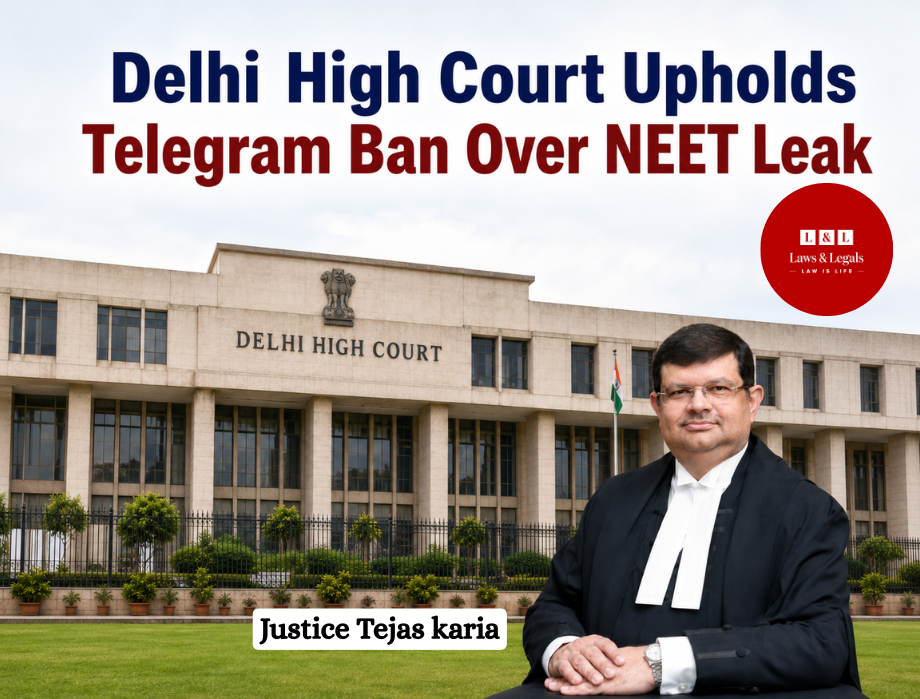
New Delhi: The Delhi High Court on Friday refused to grant any relief to Telegram and upheld the government’s decision to temporarily restrict access to the messaging platform over concerns the NEET paper leak.
Justice Tejas Karia while dismissing Telegram plea against banning order, said government was empowered under norms to direct blocking of access to Telegram, test of proportionality is satisfied and held that the step was not disproportionate as the messaging app can facilitate “automated dissemination” of large content.
“The blocking of individual content was undertaken pursuant to the 2021 Rules, whereas the Impugned Order under Section 69A of the IT Act was passed upon consideration of the overall architectural features of Telegram, which rendered it impracticable to prevent misuse of the platform through the less restrictive measure of blocking individual items of content alone,” the court said.
In its 39-page verdict, the HC found that the decision of the Ministry of Electronics and Information Technology (MeitY) under Section 69A of the Information of Technology Act was taken to ensure a fair re-examination of the National Eligibility-cum-Entrance Test (Undergraduate), on June 21.
The National Testing Agency on May 12 cancelled the NEET-UG test amid allegations of a paper leak.
“The Final Order reiterates that the interests of approximately 2.2 million candidates appearing in the NEET UG, 2026 examination were required to be protected and that any potential disruption to public order had to be averted. It is in that context that Respondent No. 1 (Centre) concluded that temporary blocking of public access to Telegram was necessary for securing the aforesaid objective,” the court said.
“It is, therefore, evident that both the Impugned Order and the Final Order are founded upon relevant material duly considered by Respondent No. 1, and that the conclusions recorded therein are supported by the reasons set out in the said Orders,” the court said holding that the orders do not suffer from the vice of non-application of mind, as alleged by the petitioners (Telegram).
The Petitioners contend that the measures of blocking of access to Telegram until June 22 and the disabling of the message-editing feature until June 30, do not constitute the least restrictive means for achieving the stated objective and, therefore, fail the test of proportionality.
Countering it, the government submitted that, having regard to the mechanism employed by Telegram and the architecture of the platform, which enables rapid and widespread dissemination of information, the impugned measures constitute the least restrictive means available for achieving the legitimate objective stated in the Orders.
Any subsequent editing of messages relating to NEET UG, 2026 may mislead general public and, consequently, give rise to a potential public order situation, the court observed.
“The Orders expressly record that entity-specific interventions, including the reporting and removal of channels, groups, bots, and accounts, were repeatedly found to be ineffective and inadequate. Further, the audience-migration mechanisms enable operators to rapidly reconstitute networks after enforcement action was taken by the concerned authorities,” the court said.
“In the present case, the NEET UG, 2026 examination is scheduled to be conducted on 21.06.2026. The temporary blocking of Telegram under the Orders is operative only until 22.06.2026, while the disabling of the message-editing feature is confined to the period until 30.06.2026. The limited temporal scope of these measures demonstrates that they are narrowly tailored and confined to the period strictly necessary for securing the stated objective.”