






New Delhi: The Supreme Court has delivered an important ruling on railway accident compensation, holding that a compensation claim cannot be rejected merely because the deceased passenger’s train ticket was not recovered after the accident.
The Court said that if a passenger dies after falling from a moving train, the absence of the ticket does not automatically mean that the person was travelling without a valid ticket. If other evidence shows that the passenger had lawfully purchased a ticket and was travelling on the train, the family is entitled to compensation.
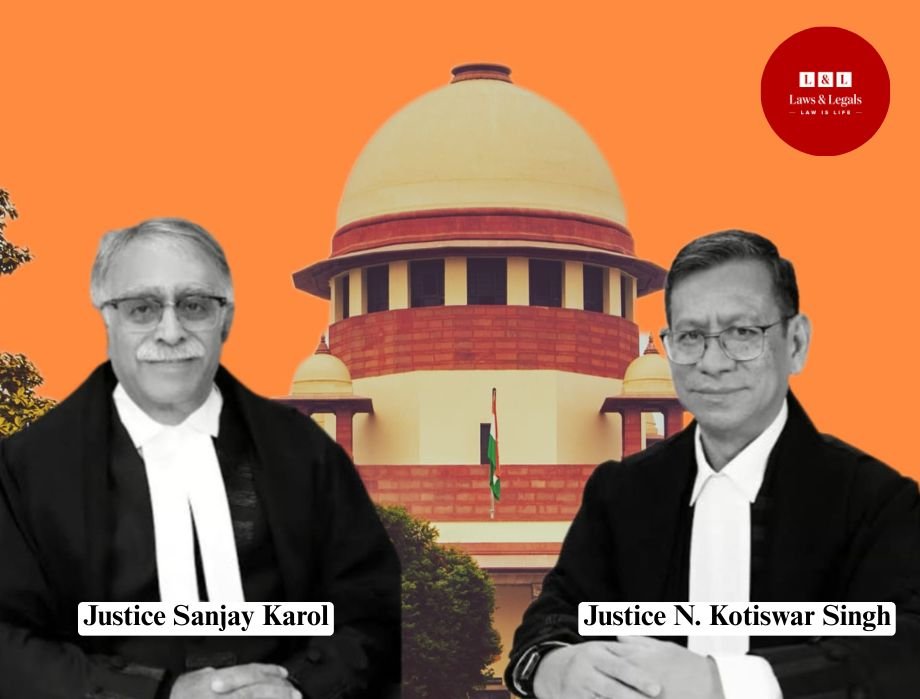
The judgment was delivered by a Bench of Justice Sanjay Karol and Justice N. Kotiswar Singh, which emphasized that the Railway compensation law is a beneficial piece of legislation meant to provide timely relief to victims and their families. Therefore, it should be interpreted in a humanitarian and practical manner rather than on technical grounds.
The case arose from the death of Chandrakant Thakkar, a resident of Raipur, Chhattisgarh, who died in November 2015 after falling from a moving train while travelling from Raipur to Ahmedabad.
His wife approached the Railway Claims Tribunal seeking compensation. She stated that her husband had purchased a valid train ticket but had kept it inside his travel bag. After the accident, the bag went missing and was never recovered by the police. She consistently maintained this version in her affidavit and throughout the proceedings.
The Railway did not dispute that Chandrakant Thakkar had been travelling on the train or that he died in the accident. The only issue was whether he could be treated as a bona fide passenger when the ticket was not recovered.
The Railway Claims Tribunal rejected the claim, holding that since no ticket was found, it had not been proved that the deceased was travelling with a valid ticket.
The Madhya Pradesh High Court upheld this decision, also noting minor inconsistencies regarding the date of travel mentioned by the family.
The Supreme Court disagreed with both decisions. It held that the Tribunal and the High Court had focused only on the missing ticket while ignoring the surrounding circumstances and other available evidence. The Court observed that it is neither impossible nor unusual for a ticket or travel bag to go missing in a railway accident.
The Court noted that the widow had consistently maintained that her husband had purchased a valid ticket and that it was lost along with the missing travel bag. There was also no evidence produced by the Railway to show that the deceased was travelling without a ticket.
The Supreme Court clarified that a train ticket is important evidence, but it is not the only evidence in such cases.
Courts should also consider affidavits filed by family members, police records, accident reports, and other surrounding circumstances. If these materials indicate that the deceased was a bona fide passenger, compensation cannot be denied merely because the physical ticket was not recovered.
The Court further held that once the family places credible material before the court showing that the deceased had purchased a valid ticket, the burden shifts to the Railway to prove otherwise.
The Bench also explained that claims under Section 124A of the Railways Act are based on the principle of “no-fault liability.” This means that where an “untoward incident,” such as falling from a moving train, results in death or injury, the victim or the victim’s family is not required to prove negligence on the part of the Railway in order to claim compensation.
Apart from deciding the compensation dispute, the Supreme Court also made important observations on railway safety. It noted that railway authorities are responsible for ticket checking, crowd management, passenger safety, and ensuring proper precautions before trains depart.
The Court observed that effective implementation of these safety measures could prevent many accidents. At the same time, it reminded passengers to avoid risky practices such as boarding moving trains or travelling on footboards.
Allowing the appeal, the Supreme Court set aside the judgments of the Madhya Pradesh High Court and the Railway Claims Tribunal. It directed the Railway to pay ₹8 lakh in compensation to the deceased’s widow within four weeks.
The Court also ordered that if the payment is delayed, the amount will carry 8% annual interest from the date the compensation claim was originally filed.
The judgment is significant because it makes clear that the absence of a recovered train ticket, by itself, cannot deprive the family of a railway accident victim of compensation. Courts must examine all available evidence and adopt a welfare-oriented approach consistent with the purpose of the Railway compensation law.