



New Delhi: The Supreme Court has ruled that an accused person who deliberately absconds cannot escape prosecution simply because an important witness dies during the period of absconding. If the legal conditions are satisfied, the witness’s earlier recorded testimony can still be used as evidence against the accused after their arrest.
The Court said that the law does not allow an accused to benefit from their own wrongdoing. If a person intentionally remains absconding for years and, during that time, a key witness dies, they cannot later argue that the witness’s statement should be discarded because they did not get an opportunity to cross-examine the witness.
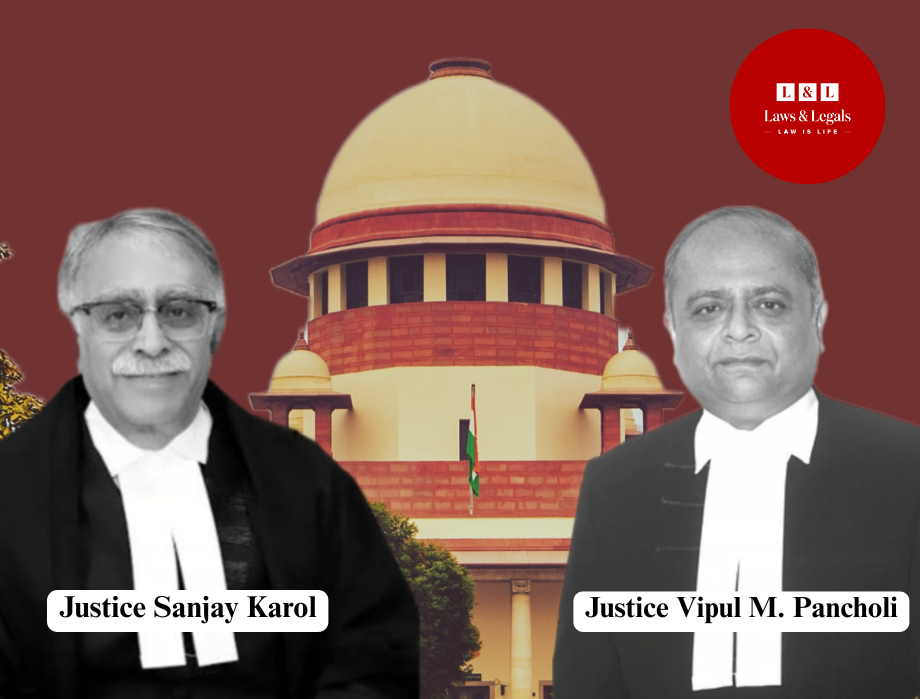
The judgment was delivered by a Bench of Justice Sanjay Karol and Justice Vipul M. Pancholi while setting aside a decision of the Calcutta High Court.
The case arose from a 2012 gang rape in Kolkata. The victim alleged that she was abducted in a car, gang raped at gunpoint, and thrown out of the moving vehicle. Police arrested three accused, but two others remained absconding for several years despite arrest warrants and proclamation proceedings.
The trial against the three arrested accused continued separately. During that trial, the victim testified in court and was cross-examined by the defence lawyers representing those accused. The victim died in 2015, and the three accused were later convicted.
The two absconding accused were arrested in 2016, after the victim’s death. During their separate trial, the prosecution sought to rely on the victim’s earlier recorded testimony.
The trial court allowed it, but the Calcutta High Court set aside that order, holding that the trial court had not passed a formal order under Section 299 of the Code of Criminal Procedure (now Section 336 of the Bharatiya Nagarik Suraksha Sanhita) when recording the evidence.
The West Bengal Government challenged the High Court’s decision before the Supreme Court.
The Supreme Court held that the absence of a formal order under Section 299 was not decisive. What mattered was whether the accused had actually been absconding and whether there was no immediate prospect of their arrest. If these conditions are established from the record, the earlier testimony can be used later if the witness has died or cannot be produced.
The Court noted that in this case, arrest warrants had been issued, proclamation proceedings had been initiated, the charge sheet described the accused as absconders, and they remained untraceable for several years.
The victim’s testimony was recorded in 2013, she died in 2015, and the absconding accused were arrested only in 2016. Therefore, all the legal requirements for using her earlier testimony were satisfied.
The Supreme Court also warned that accepting the High Court’s view would encourage accused persons to evade arrest in the hope that witnesses may die or become unavailable over time, allowing them to challenge the evidence later. Such an interpretation, the Court said, would undermine the administration of justice.
However, the Court clarified that earlier recorded testimony does not automatically become admissible in every case.
It can be used only when the statutory conditions are fulfilled, including proof that the accused was absconding and there was no immediate possibility of arrest, and that the witness has subsequently died, become incapable of giving evidence, or cannot be produced before the court.
Accordingly, the Supreme Court set aside the Calcutta High Court’s judgment and restored the trial court’s order, holding that the deceased victim’s earlier testimony is admissible as evidence against the absconding accused.
The ruling makes it clear that an accused cannot seek relief merely because a witness died while they were deliberately avoiding the legal process. If the legal requirements are met, the witness’s previously recorded evidence can be relied upon in the subsequent trial.