





Jodhpur: In a significant ruling reaffirming the principles of natural justice, the Rajasthan High Court has held that an officer who has approved an investigation or prosecution proposal cannot subsequently adjudicate the same matter as a quasi-judicial authority, as it gives rise to a reasonable apprehension of bias.
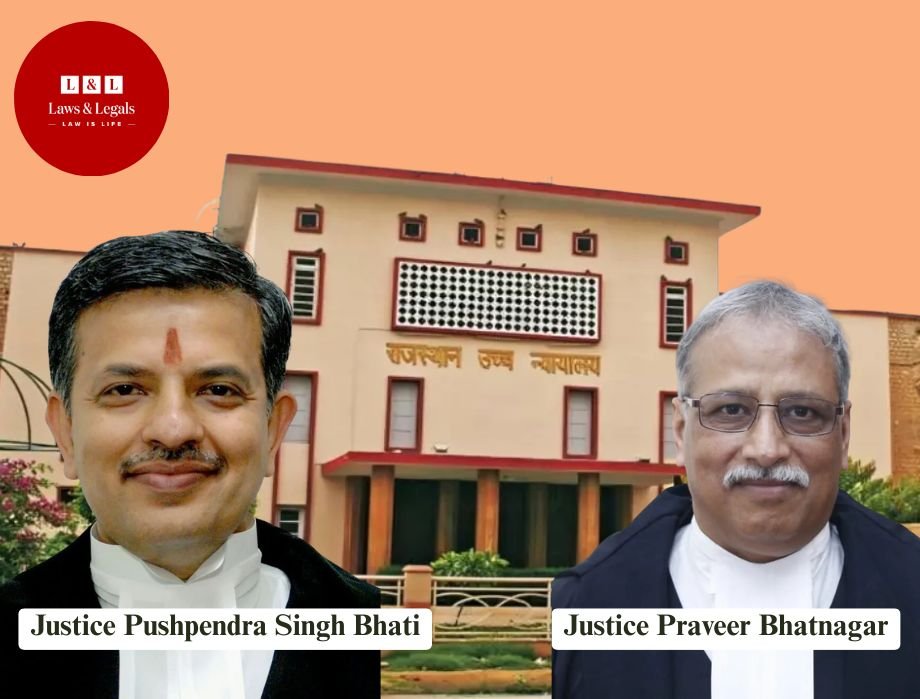
A Division Bench comprising Justice Pushpendra Singh Bhati and Justice Praveer Bhatnagar quashed the GST penalty order and the appellate order passed against M/s Gajmukhi Bullion, holding that the same officer’s dual role in the investigation and adjudication process undermined the fairness expected of quasi-judicial proceedings.
The writ petition was filed by M/s Gajmukhi Bullion, a proprietorship firm engaged in the business of bullion, gems and jewellery, challenging an order dated 16 January 2025 imposing penalties under Section 122 of the Central Goods and Services Tax Act, 2017, along with the appellate order dated 28 January 2026 affirming the penalties.
The petitioner contended that Shri Mahipal Singh, Additional Commissioner, had earlier examined and approved the investigation report recommending prosecution under Section 132 of the CGST Act. Despite his prior involvement, the same officer later acted as the quasi-judicial authority and adjudicated the show-cause notice arising out of the very same facts. According to the petitioner, this violated the fundamental principle that no person should be a judge in his own cause.
The petitioner in the matter contended that once the Additional Commissioner had approved the proposal for prosecution, he had already formed an opinion regarding the allegations. Therefore, his subsequent role as the adjudicating authority created a reasonable apprehension of bias and vitiated the proceedings.
Reliance was placed on the Supreme Court’s landmark judgment in Ashok Kumar v. State of Haryana, which reiterates that justice must not only be done but must also appear to have been done, and that even a reasonable likelihood of bias is sufficient to invalidate a decision-making process.
The GST Department on the other place stated that the officer’s role in approving the investigation report was distinct from his role as a quasi-judicial authority. It contended that no actual prejudice had been caused to the petitioner merely because the same officer had discharged both functions.
Rejecting the Revenue’s stand, the Division Bench observed that the same Additional Commissioner had approved the investigation report and later passed the adjudication order, thereby assuming multiple roles in the same proceedings.
The Court held that such an arrangement strikes at the very foundation of impartial decision-making expected from a quasi-judicial authority. It observed that while it was unnecessary to determine whether the officer was actually biased, the reasonable apprehension of bias in the mind of the assessee was sufficient to vitiate the proceedings.
The Bench reiterated that the doctrine of natural justice extends beyond courts to administrative and quasi-judicial authorities, and public confidence in adjudicatory processes requires not only fairness but also the appearance of fairness.
Accordingly, the Rajasthan High Court quashed the Order-in-Original dated 16 January 2025 and the Order-in-Appeal dated 28 January 2026, remanding the matter for fresh adjudication.
The Court directed that the matter be decided afresh by the competent authority, ensuring that the roles of investigator, approving authority and quasi-judicial officer are not performed by the same individual.
Court also clarified that it had not examined the merits of the GST demand or determined whether actual bias existed, leaving all other issues open for consideration during the fresh proceedings.