






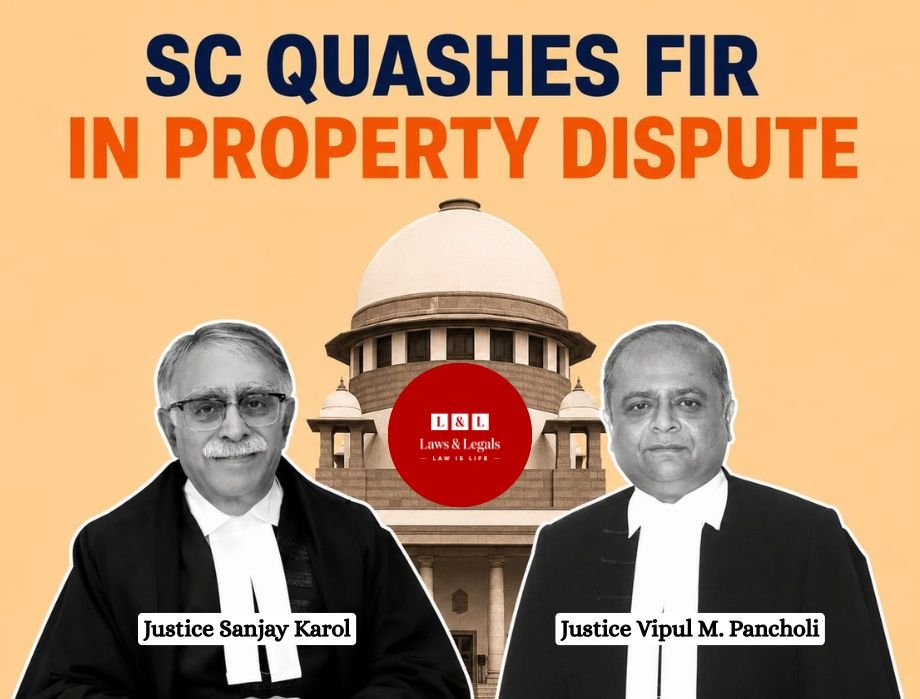
New Delh: The Supreme Court of India has delivered a major judgment saying that civil disputes — especially property and ownership disputes — should not be turned into criminal cases just to pressure or harass the other side.
The Court warned that criminal law cannot be misused as a “weapon of harassment and coercion.”
The case came from Gujarat and involved a 16-year-old dispute over ownership of a piece of land in Surat district. Two groups had already been fighting in civil courts since 2000 over who legally owned the property.
Later, in 2009, one side filed a criminal FIR accusing the other side of serious offences like cheating, forgery, extortion, conspiracy, and intimidation under several IPC sections including 420, 467, 468, 471, 384, and 120-B.
The accused argued that these criminal allegations were false and were added only to put pressure on them in the ongoing civil property dispute. They said that for many years no one had ever alleged forgery or extortion, and suddenly serious criminal charges were introduced much later.
The Gujarat High Court refused to cancel the FIR, after which the matter reached the Supreme Court.
A bench of Justices Sanjay Karol and Vipul M. Pancholi examined the record and agreed with the accused.
The Supreme Court observed that the dispute was essentially civil in nature because it related to land title and ownership rights. The Court noticed that allegations like extortion, threats, and money demands appeared much later and looked like “afterthoughts” added to give the dispute a criminal colour.
The Court also questioned why the complainant waited nearly 9 years to raise serious criminal allegations if such offences had genuinely occurred.
The judges made an important legal point:
A disagreement over ownership of property does not automatically amount to forgery.
Just because someone claims ownership and executes documents in support of that claim does not mean the documents are automatically “false documents.”
Title disputes should normally be decided by civil courts, not criminal courts.
The Court relied on the earlier Supreme Court judgment in Mohd. Ibrahim v. State of Bihar, which had similarly clarified that property ownership disputes should not casually be treated as criminal forgery cases.
The Supreme Court strongly stated:
“Criminal process cannot be permitted to become a weapon of harassment and coercion in disputes concerning title over immovable property.”
The Court further explained that if every land or family property dispute is converted into a criminal case, it would lead to misuse of the criminal justice system and unnecessary harassment of people.
Another important observation was regarding old criminal records. The Gujarat High Court had relied partly on the accused persons’ past criminal antecedents while refusing to quash the FIR. But the Supreme Court said that previous criminal history alone cannot justify allowing a doubtful FIR to continue. Every case must be judged on its own facts.
The Court also clarified the role of High Courts under Section 482 CrPC (inherent powers). It said High Courts are expected to intervene when criminal proceedings appear to be an abuse of legal process, especially where:
the dispute is fundamentally civil,
criminal allegations are added later,
and the FIR appears intended to pressure the opposite party.
Finally, the Supreme Court set aside the Gujarat High Court’s order and completely quashed the FIR and all related criminal proceedings.
However, the Court clarified that the ongoing civil cases over the property will continue normally. The judgment only ends the criminal proceedings, not the civil litigation.
Why this judgment is important:
This ruling is being seen as a major precedent across India because property disputes and family inheritance fights are often converted into criminal complaints to intimidate opponents.
The judgment sends a strong message that:
civil disputes should not be given a fake criminal colour,
criminal law cannot be used for pressure tactics,
and courts must stop misuse of the criminal justice system.
It is likely to have a significant impact on future property litigation and cases involving misuse of criminal complaints in India.