





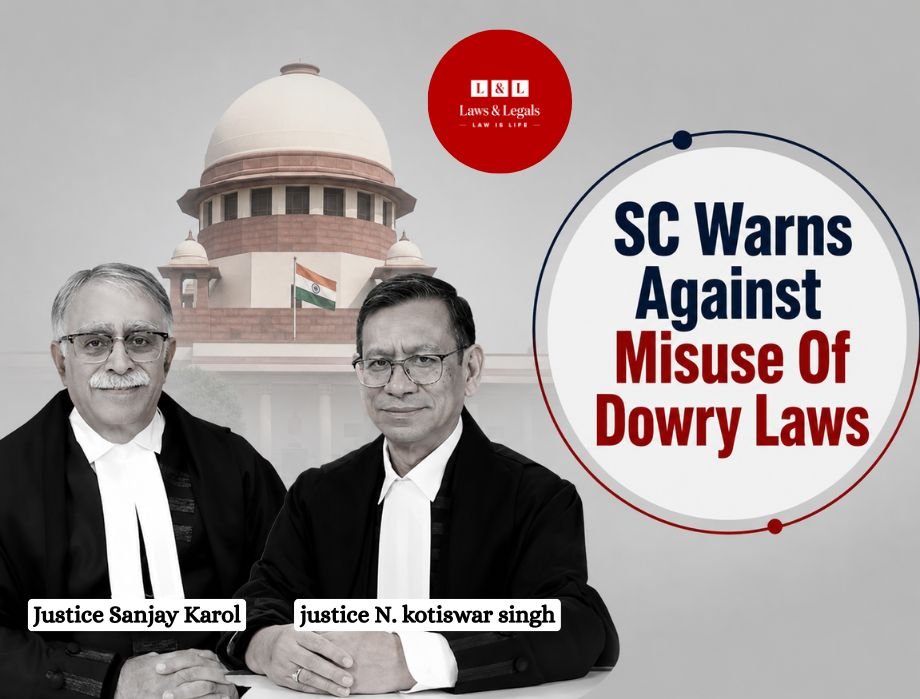
New Delhi: The Supreme Court has delivered an important judgment on dowry harassment and matrimonial dispute cases, saying that the criminal justice system should not be misused to drag an entire family into legal trouble without clear evidence.
The judgment was delivered by a bench of Justice Sanjay Karol and Justice Nongmeikapam Kotiswar Singh while hearing a case from Madhya Pradesh.
The Court clarified that merely being related to the husband is not enough to make someone an accused in a dowry harassment or domestic violence case. It said that every accused person must face specific, clear, and separate allegations. General or vague accusations against the husband’s entire family are not sufficient for criminal prosecution.
The judges also observed that family members cannot be treated as criminals simply because they advised the couple to “adjust,” “compromise,” or “save the marriage.” According to the Court, such advice may or may not be morally appropriate, but it does not automatically amount to a criminal offence.
The case arose from a matrimonial dispute in the Guna district of Madhya Pradesh. The woman got married in November 2019, and after some time disputes began between the husband and wife. In January 2023, the woman filed an FIR alleging dowry harassment, mental cruelty, demands for money, threats, and controlling behaviour. Along with her husband, several members of his family were also named as accused.
The woman alleged that she was mentally harassed, her activities were monitored, and she was subjected to pressure and threats. The husband’s relatives approached the Madhya Pradesh High Court seeking cancellation of the criminal proceedings, but the High Court refused relief, saying there was enough material for the case to continue. The family then approached the Supreme Court.
After examining the complaint and related documents, the Supreme Court found that the allegations against the husband’s relatives were vague and general. The complaint did not clearly explain who committed which act, when it happened, or how each individual was involved. The Court emphasized that criminal law requires individual responsibility and that a person cannot face trial simply because they belong to the husband’s family.
The Court further observed that some relatives may remain silent or avoid involvement during marital disputes. Even if such behaviour appears insensitive, it cannot automatically be treated as a criminal act unless there is proof that the person actively participated in harassment or cruelty.
The Supreme Court also warned against misuse of criminal laws in matrimonial conflicts. It said that when relationships break down emotionally, there is often a tendency to implicate the entire family, which can amount to abuse of the legal process. The judges stressed that courts must carefully examine matrimonial complaints before allowing prosecution against every family member.
During the hearing, it also came to light that the marriage had already ended. In view of this, the Supreme Court terminated the domestic violence proceedings against the husband’s relatives as well. However, the Court clarified that the woman remains free to pursue legal remedies against her husband if she chooses.
Finally, the Supreme Court set aside the High Court’s order and quashed all criminal proceedings against the husband’s relatives. The Court held that continuing the case against them would amount to misuse of the judicial process.
The judgment is being seen as an important precedent for future dowry harassment, domestic violence, and matrimonial dispute cases across India. The Supreme Court sought to balance the need to protect women from genuine abuse with the need to protect innocent relatives from false or exaggerated allegations. The ruling reinforces that justice requires both punishment for the guilty and protection for the innocent.