



Jodhpur: The Rajasthan High Court has delivered an important judgment on when the death penalty can be awarded. The Court said that a death sentence should be given only in cases where life imprisonment is completely inadequate.
It reaffirmed that death sentence is the exception and life imprisonment is the rule. The Court also observed that hanging should always be the last option, not the first.
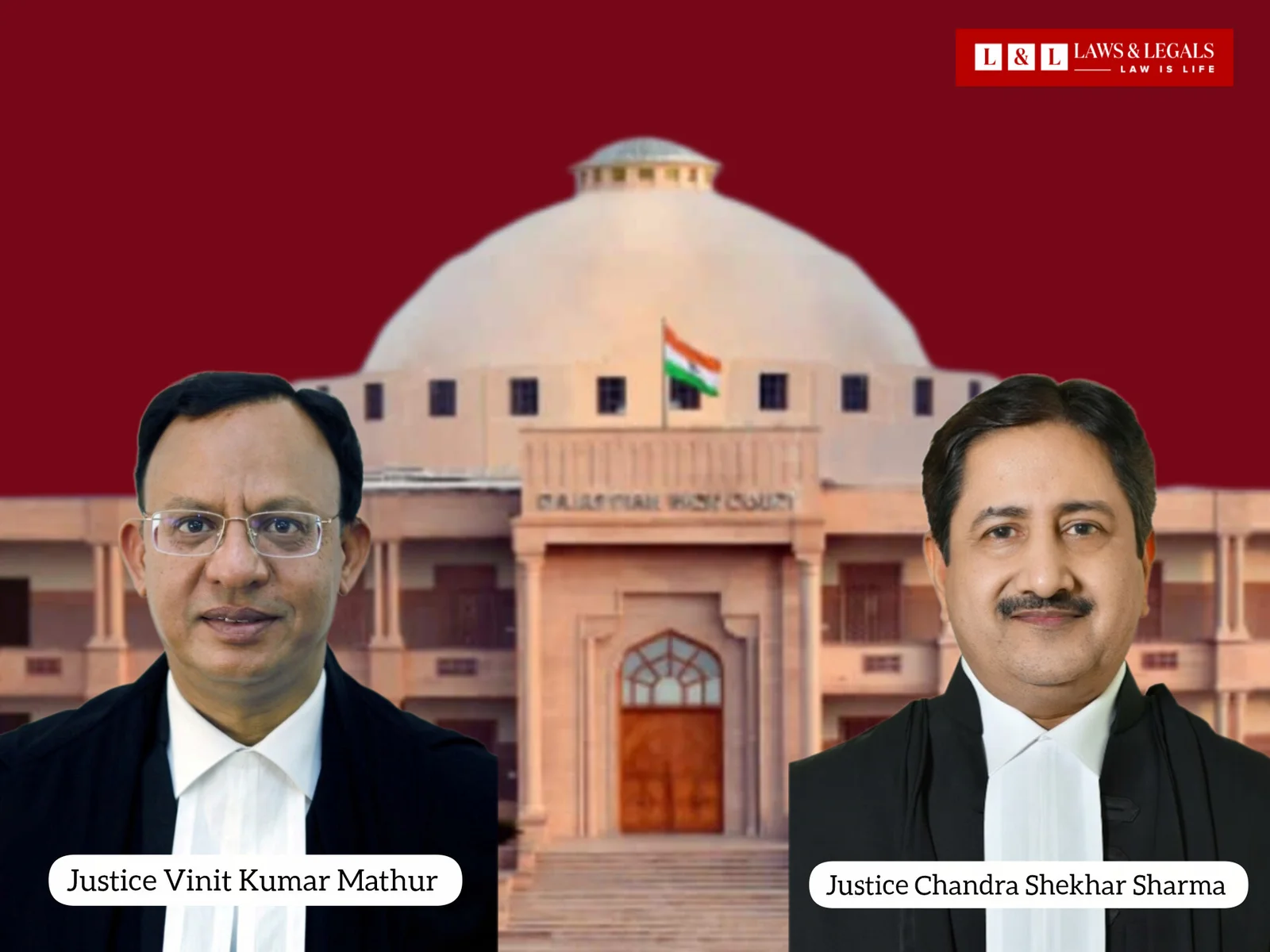
The judgment was delivered by a Division Bench of Justice Vineet Kumar Mathur and Justice Chandrashekhar Sharma while hearing the death reference sent by the trial court and the appeals filed by convicts Pahad Singh and Dungar Singh in a 2023 double murder case from Jalore district.
While the High Court upheld their conviction for murder and other offences, it reduced their death sentence to life imprisonment.
The case relates to an incident that took place on 3 March 2023 over a dispute involving an Ata-Sata marriage, a traditional practice where two families exchange brides.
According to the prosecution, the two accused went to the house of Indra Kanwar carrying axes and pressured her to agree to an Ata-Sata marriage involving her daughter, Rinku Kanwar. When Indra Kanwar asked them to discuss the matter after her husband returned home, the accused allegedly attacked her with axes.
Hari Singh, who came to save her, was also attacked and died on the spot. The accused then attacked several other family members, leaving many seriously injured. The attack stopped only after the police reached the spot. Police later arrested both accused and recovered blood-stained axes.
In the High Court, the defence argued that the trial court had wrongly assessed the evidence. It claimed there were contradictions in the FIR and witness statements, and that the prosecution mainly relied on family members of the victims instead of independent witnesses.
The defence also said the accused had been falsely implicated because of an old land dispute and argued that the incident happened suddenly during a quarrel, not as a planned murder. It also questioned the recovery of the weapons and said the case did not fall under the “rarest of rare” category required for awarding the death penalty.
The State opposed the appeals and argued that the prosecution had proved the case beyond reasonable doubt. It relied on eyewitnesses, injured witnesses, medical evidence, post-mortem reports, forensic reports and the recovery of the weapons to support the conviction.
The State requested the High Court to uphold the death sentence awarded by the trial court.
After examining the evidence, the High Court agreed that the prosecution had proved the guilt of both accused beyond reasonable doubt. It found that the eyewitnesses and injured witnesses gave reliable statements, which were supported by medical and forensic evidence.
The Court also held that the recovery of the blood-stained axes strengthened the prosecution’s case. It concluded that both accused had acted with a common intention to kill Indra Kanwar and Hari Singh and had also attempted to murder several others.
However, the High Court said that although the crime was serious and brutal, it was not a “rarest of rare” case where only the death penalty would be appropriate. The Court said that before awarding a death sentence, it must be clear that life imprisonment is not enough to meet the ends of justice.
Since that was not the case here, it reduced the death sentence of both convicts to life imprisonment while keeping their conviction and all other punishments unchanged.
The High Court also clarified another important legal point. It said that a witness’s statement cannot be rejected just because the witness is related to the victim. If the witness’s testimony is natural, trustworthy and supported by other evidence, it can be relied upon for conviction. In this case, the Court found that the eyewitnesses and injured witnesses were reliable and that their statements were supported by medical and forensic evidence.