




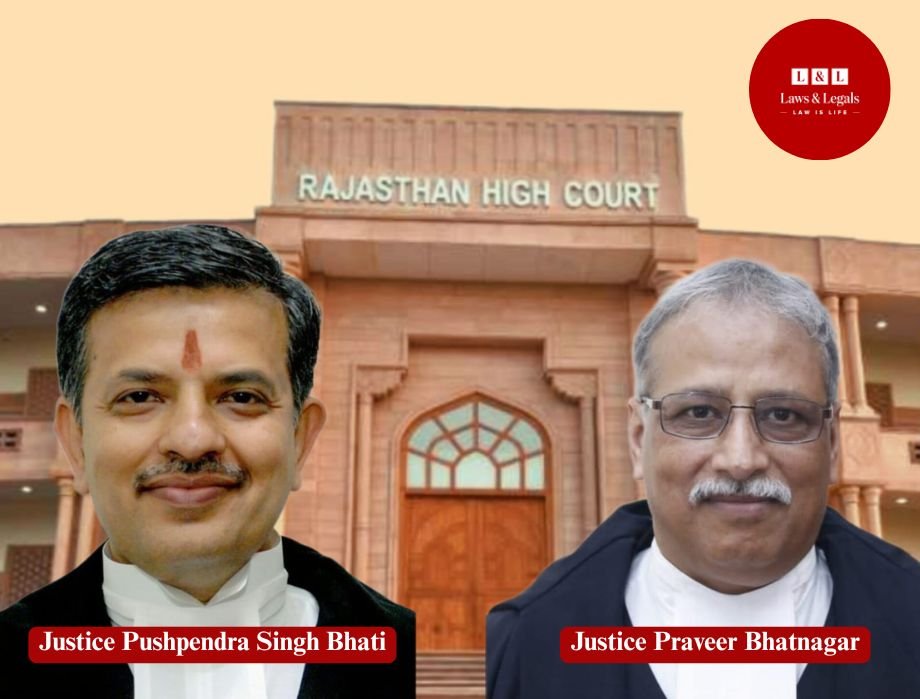
Jodhpur: In a significant ruling, the Rajasthan High Court has held that pasture land cannot become private Khatedari land merely because of incorrect revenue entries, reaffirming that statutory provisions prevail over mistaken records.
A Division Bench of Justice Pushpendra Singh Bhati and Justice Praveer Bhatnagar allowed the State’s appeal, set aside the orders of the Board of Revenue and the Single Judge, and directed that the disputed revenue entries be corrected in line with the District Collector’s findings.
The dispute concerned land in Jaisalmer which, under the inventory prepared after the Rajasthan Land Reforms and Acquisition of Land-Owners Estates Act, 1963, was recorded as pasture land where the former ruler had only grazing and fodder-cutting rights. However, during settlement, the land was mistakenly entered as Khatedari land in the names of the former ruler’s legal heirs. The State sought correction of these entries.
The Board of Revenue had rejected the State’s plea, stating that there was insufficient material to justify changing the entries, and the same decision has been upheld by Single Judge.
The High Court, however, disagreed. It held that the official inventory clearly showed the land to be pasture land. Referring to Section 6 of the 1963 Act and Section 16 of the Rajasthan Tenancy Act, 1955, the Court said Khatedari rights cannot be granted over pasture land. It observed that incorrect revenue entries cannot create ownership when the law itself does not permit it.
The Court also rejected the plea of res judicata, noting that the earlier reference had only been withdrawn and was never decided on merits. The Bench also found no unreasonable delay in initiating the reference, observing that the first proceedings ended without a decision and the subsequent reference was made within a reasonable period considering the facts of the case.
Consequently, the Court directed that the disputed revenue entries be corrected in accordance with the District Collector’s order dated April 25, 1989, restoring the legal position that the land is pasture land and vested in the State.
In a connected appeal, the Court also dismissed the plea of another group of appellants seeking to be added as parties to the case. It held that they had not claimed any rights over the disputed land and were neither necessary nor proper parties to the dispute between the State and the legal heirs of the former ruler.