


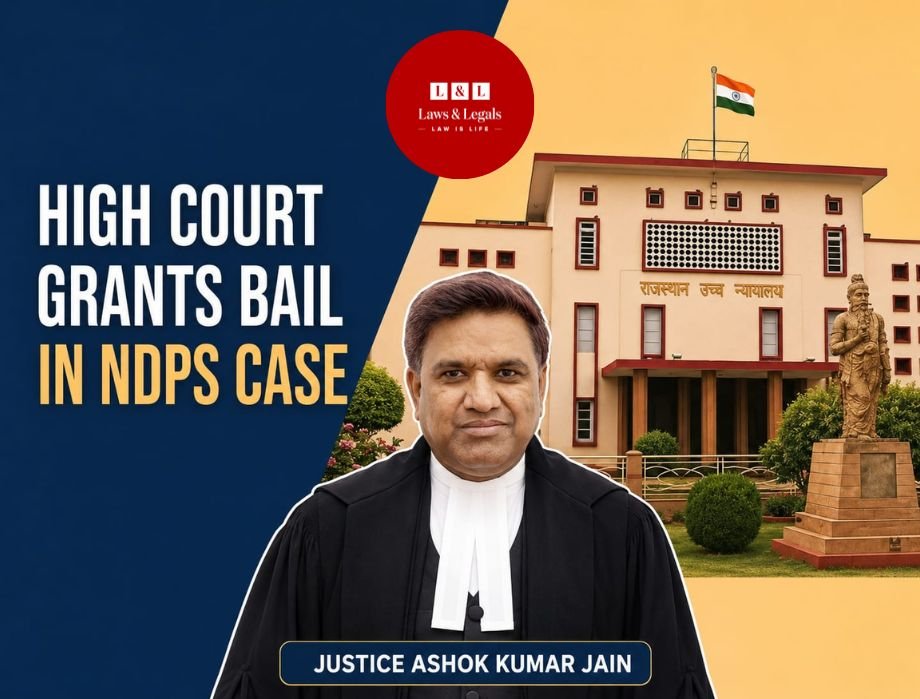
Jaipur: The Rajasthan High Court has granted bail to Prabhu Dayal Gurjar in a major NDPS (drug trafficking) case after he spent more than four years in jail while the trial remained incomplete.
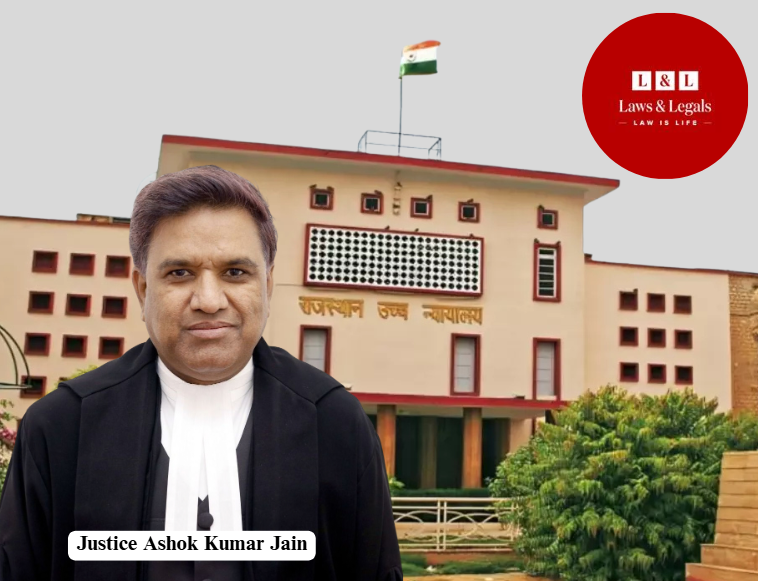
Justice Ashok Kumar Jain said that keeping an accused in jail indefinitely is not justified when the trial is moving very slowly and a similarly placed co-accused has already been granted bail by the Supreme Court.
The case relates to an FIR registered in 2020 at Mangalwad police station in Chittorgarh district under Sections 8/15 and 8/29 of the NDPS Act.
According to court records, on 15 May 2020, police received information about drug trafficking and stopped a truck bearing registration number RJ-09-GA-2363. During the search, police allegedly recovered 3 quintals and 9 kilograms of doda post (poppy husk) from 11 plastic bags and 6 sacks loaded in the truck.
At the time, the truck was being driven by Jagdish and Dinesh Ram was also present in the vehicle. During interrogation, the names of Bhanwar Lal, Prakash, Prabhu, and Manoj Jat allegedly emerged as people involved in supplying and dealing with the narcotic substance.
This was Prabhu’s fourth bail application before the High Court. His earlier applications had been rejected, including the third application in April 2024, when the court said the strict conditions of Section 37 of the NDPS Act were not satisfied.
This time, however, the defence presented new circumstances. Prabhu’s lawyer argued that he had been continuously in jail since 4 October 2021 and the trial was still incomplete, with witness testimonies yet to be finished. The defence also argued that investigation against him had already been completed and there was no further need for custodial interrogation.
A major factor in the court’s decision was that co-accused Prakash, whose situation was considered similar, had already been granted bail by the Supreme Court of India in September 2024 after the High Court had earlier denied him relief. On this basis, Prabhu sought bail on the principle of parity, meaning similarly placed accused should receive similar treatment.
The Rajasthan High Court agreed that Prabhu’s situation was substantially similar to that of co-accused Prakash and said this factor could not be ignored.
The State government strongly opposed bail and argued that Prabhu had a serious criminal history. According to prosecution records, ten criminal cases were registered against him, including eight cases under the NDPS Act. Some of these cases dated back to 2011, 2017, and 2020.
Despite this, the High Court said that criminal history alone cannot justify keeping a person in jail for an unlimited period, especially when the trial is progressing slowly and many witnesses are still left to testify.
The court relied on several important Supreme Court judgments, including Satender Kumar Antil vs CBI, where the Supreme Court observed that “bail is the rule and jail is the exception.” The High Court said long incarceration and delay in trial can also be grounds for granting bail even in NDPS cases, which usually have strict bail conditions.
The court also referred to Supreme Court rulings where accused persons were granted bail because trials were delayed for years and witness examination had barely progressed.
An important observation made by the High Court was that no narcotic substance was directly recovered from Prabhu himself. The recovery was made from the truck driver Jagdish and another person traveling with him. The court said this fact was also relevant while considering bail.
Finally, the High Court granted bail with strict conditions. Prabhu has been ordered to furnish a personal bond of ₹50,000 along with two sureties of the same amount.
The court also directed him to appear at Mangalwad police station on the first and third Wednesday of every month. He has been warned not to influence witnesses, tamper with evidence, or involve himself in any criminal activity in the future. The court said violation of these conditions could lead to automatic cancellation of bail.