




New Delhi: The Supreme Court has issued an important clarification on its landmark May 2025 judgment regarding pensions for retired High Court Chief Justices and judges. The court has now made it clear that the revised pension scheme ordered in 2025 will be treated as effective from October 9, 2016.
This clarification has ended the confusion over the date from which retired judges would receive the benefit of the increased pension and from when arrears would be calculated.
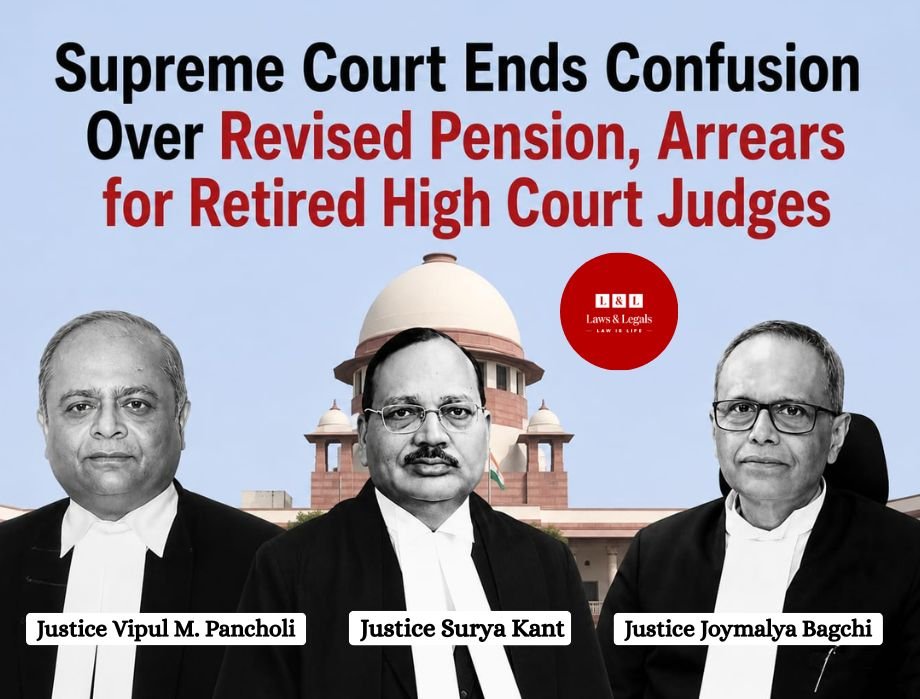
A bench led by Chief Justice Surya Kant along with Justices Joymalya Bagchi and Vipul M. Pancholi passed the clarification while hearing an application filed by the Central Government.
The court said that retired High Court Chief Justices would be entitled to a full annual pension of ₹15 lakh, while other retired High Court judges would receive ₹13.5 lakh annually. The court clarified that these revised pension amounts would be applicable from October 9, 2016, and arrears would also be calculated from the same date.
The dispute had been going on for years over pension inequality among retired High Court judges. Many retired judges argued that judges who retired at different times or entered the High Court through different routes were receiving significantly different pensions despite serving on the same constitutional post. Some judges had been promoted from the district judiciary, while others were directly appointed from legal practice. Different Pay Commission recommendations over the years also created major differences in pension structures.
The matter was being heard by the Supreme Court in the case titled “In Re: Refixation of Pension Considering Service Period in District Judiciary and High Court.” In May 2025, a three-judge bench headed by former Chief Justice B. R. Gavai delivered a landmark ruling applying the principle of “One Rank One Pension” to the judiciary. The court held that retired judges occupying the same constitutional office could not be treated differently merely because of their retirement date or the source of their appointment.
In that judgment, the Supreme Court directed that retired High Court Chief Justices should receive ₹15 lakh annual pension and retired High Court judges should receive ₹13.5 lakh annual pension. The benefit was also extended to Additional Judges. However, the judgment did not clearly specify the effective date of implementation, which led the Central Government to seek clarification from the court.
Attorney General R. Venkataramani informed the court that the earlier judgment did not clearly mention from which date the revised pension would apply, when arrears should be calculated from, and how cases of judges who retired before October 9, 2016 should be treated.
The Supreme Court has now clarified that revised full pension will be admissible from October 9, 2016 and arrears will also be calculated from that date. The court further clarified that judges who retired before October 9, 2016 would have their arrears calculated under the pre-revised maximum pension structure so that they are not unfairly excluded.
The court emphasized that pension equality is important to maintain the dignity and independence of the judiciary. It said that if the principle of “One Rank One Pension” can apply to the armed forces and other services, similar equality should also exist within the judiciary. The court observed that judges holding the same constitutional office should not receive unequal pensions merely because they retired on different dates.
The clarification is expected to financially benefit a large number of retired High Court judges and former Chief Justices across the country. Revised pensions will now officially apply from October 9, 2016, arrears will be calculated accordingly, and long-pending pension disputes are likely to move toward resolution. The ruling is also being seen as an important precedent regarding pension parity and service conditions for constitutional office holders in India.