





New Delhi: The Supreme Court has issued important directions to courts and prison authorities across India to ensure that prisoners are not kept in jail unnecessarily after they have been granted bail, acquitted, or had their sentence suspended.
The Court expressed concern that in many cases, people continue to remain in prison for several days even after receiving relief from a court. According to the Court, this usually happens because of administrative delays, such as late uploading of court orders, delays in communicating orders to jail authorities, or lengthy paperwork.
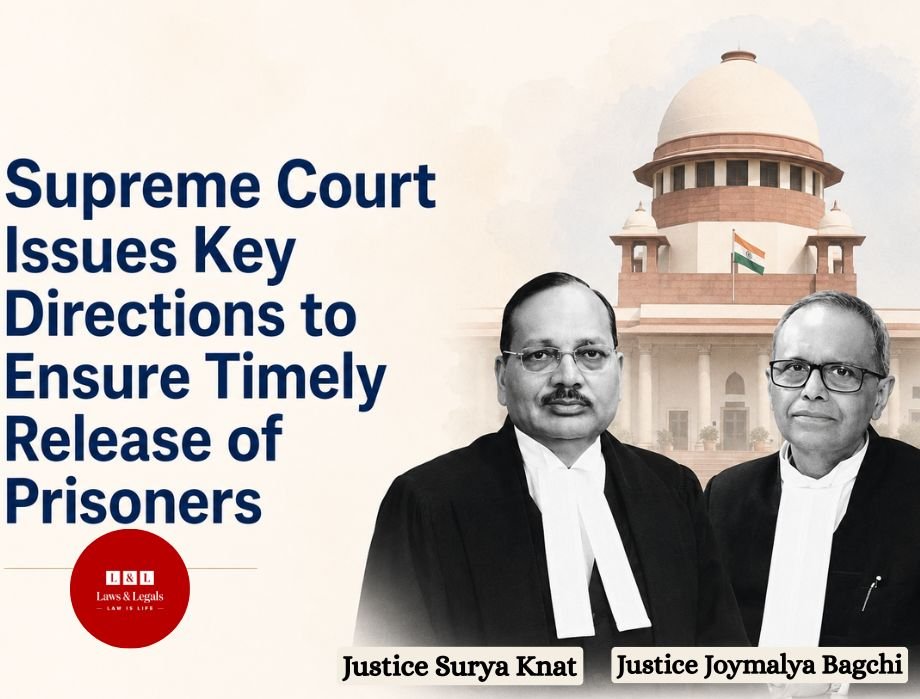
The bench of Justice Surya Kant and Justice Joymalya Bagchi said that keeping a person in jail after a court has ordered their release goes against the fundamental purpose of justice and violates their constitutional right to personal liberty.
To address the problem, the Supreme Court directed that bail orders should be pronounced and uploaded as quickly as possible, preferably on the same day. The Court also said that information about the order should reach the jail authorities immediately so that the prisoner can be released on the same day or, at the latest, the following day.
The Court clarified that exceptions may exist if the person is wanted in another case or has not fulfilled bail conditions, but otherwise there should be no unnecessary delay in release.
The Supreme Court also emphasized accountability. It said trial courts must verify whether their orders have actually been implemented and send compliance reports to the High Court that granted the relief. This is intended to ensure that court orders are not merely issued on paper but are carried out promptly.
During the hearing, the Court also addressed the issue of delayed judgments. It observed that keeping judgments reserved for long periods can result in delays in justice, particularly in criminal and bail matters. Therefore, it directed High Courts to try to pronounce reserved judgments within three months.
These directions were issued during the hearing of the case Pila Pahan @ Pila Pahan and Others v. State of Jharkhand. While examining the matter, the Court noted that delays in releasing prisoners after court orders are not limited to one state but are a nationwide problem affecting courts and prisons across the country.
The judgment reinforces the principle that once a court grants relief, a person’s liberty should not be restricted because of bureaucratic or procedural delays. The Supreme Court made it clear that no one should remain in jail longer than necessary simply because the system is slow in implementing a court’s order.